
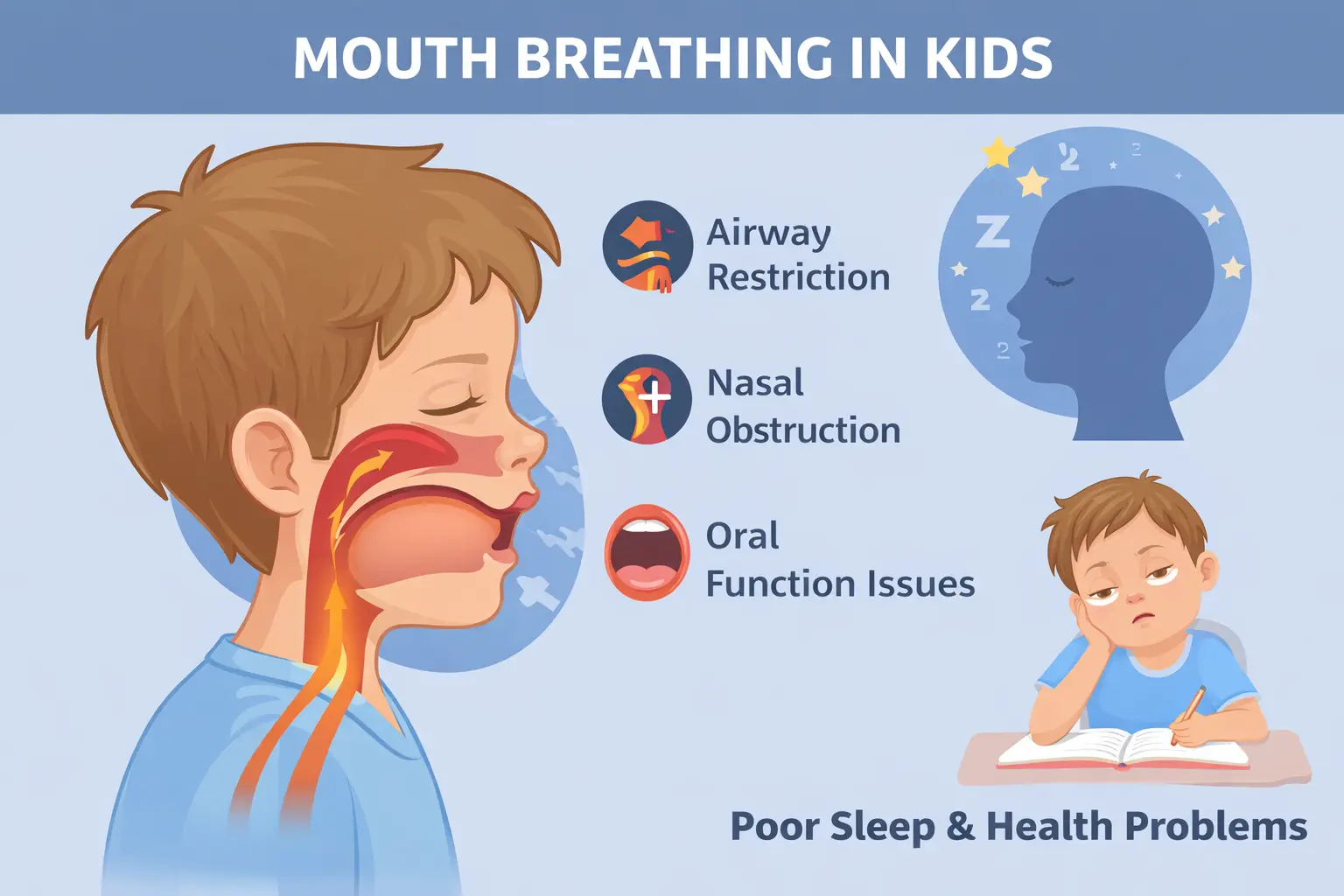
Many parents notice their child breathing through the mouth and assume it is just a habit that will go away with time. It can seem minor, especially when a child is otherwise active, healthy, and growing. In some cases, mouth breathing may come and go during allergy season or when a child has a cold. In other cases, it becomes part of everyday life and starts to feel normal.
The problem is that mouth breathing is not always just a habit. It may be a sign that something deeper is affecting the way a child breathes, sleeps, and develops. When a child breathes through the mouth during the day or while sleeping, it may reflect airway restriction, nasal obstruction, or oral function challenges that deserve closer attention. That is why the goal should never be to simply stop the symptom. The goal is to understand why it is happening in the first place.
At MyoWay Centers for Kids, we believe parents deserve clear information and a path forward when something feels off. If your child breathes through the mouth often, snores, sleeps restlessly, wakes tired, or seems to struggle with focus during the day, it may be time to look deeper at the full picture.
Why Mouth Breathing Matters
Breathing is one of the most basic functions in the body, yet the way a child breathes can influence much more than most families realize. Nasal breathing helps support healthy oxygen exchange, proper tongue posture, and balanced growth of the face and jaws. When mouth breathing becomes the default pattern, that balance can be disrupted over time.
Children are still developing, which means their bodies are constantly adapting to the patterns they use every day. If a child regularly breathes through the mouth, the lips may stay open, the tongue may not rest in the ideal position, and the muscles of the face may function differently. Over time, this can influence how the jaws grow and how the face develops.
Sleep can also be affected. A child who is not breathing well at night may not be getting the deep, restorative rest needed for healthy growth, learning, and emotional regulation. Many parents are surprised to learn that poor breathing during sleep can show up as irritability, daytime fatigue, trouble paying attention, or hyperactive behavior.
This is why mouth breathing should not be dismissed too quickly. It is often not just about the mouth. It may be about the airway, the quality of sleep, oral function, and long term development.
Common Reasons a Child May Breathe Through the Mouth
There is not one single reason every child becomes a mouth breather. That is why it is important to evaluate the full picture instead of making assumptions. A child may be breathing through the mouth for several different reasons, and more than one factor may be present at the same time.
One common reason is nasal obstruction. If the nose is not clear and open, the body may rely on the mouth as the easiest path for airflow. This can happen with chronic congestion, enlarged tissues, or structural challenges that make nasal breathing more difficult.
Another possible reason is airway restriction. When the airway is not functioning as well as it should, a child may develop compensations that affect sleep, breathing patterns, and posture. Mouth breathing may be one of the visible signs that something needs further attention.
Oral function issues can also play a role. The lips, tongue, cheeks, and jaw all work together in ways that support breathing, chewing, swallowing, and speech. When those patterns are not functioning well, breathing habits may shift over time.
What matters most is that parents do not need to guess. If mouth breathing is happening often, especially during sleep or throughout the day, it is worth taking seriously and exploring the root cause.
Signs Parents Often Notice First
Mouth breathing does not always show up alone. It is often part of a bigger pattern that parents have been noticing for months or even years without realizing the connection.
Some children sleep with their mouths open every night. Some snore regularly or make noisy breathing sounds while they sleep. Others toss and turn, wake up frequently, sweat during sleep, grind their teeth, or seem hard to wake in the morning. A child may also wake with dry lips or a dry mouth.
During the day, parents may notice open mouth posture, dark circles under the eyes, low energy, irritability, or trouble focusing. Some children seem constantly congested. Others have crowded teeth, narrow jaws, or changes in facial development that become more obvious over time.
None of these signs alone tells the full story. Still, when several of them appear together, they can point to the need for a closer look at breathing, sleep, and oral function.
Parents know their children best. If something feels off, it is worth trusting that instinct.
How Mouth Breathing Can Affect Sleep Quality
Sleep is one of the most important parts of healthy childhood development. It supports growth, learning, behavior, memory, mood, and physical recovery. When a child is not breathing well during sleep, those benefits can be harder to achieve.
A child who breathes through the mouth at night may experience more disrupted sleep, even if no one fully notices it in the moment. The sleep may appear long enough on paper, but the quality may not be what the body and brain need. Some children wake often without fully becoming alert. Others move constantly, snore, or seem restless throughout the night.
Over time, poor sleep can affect how a child feels and functions during the day. Parents may notice emotional ups and downs, difficulty with attention, or behavior that seems out of proportion to the situation. Teachers may notice that a child has trouble staying on task. Families may begin searching for answers in several different places without realizing that breathing and sleep could be part of the conversation.
This does not mean mouth breathing explains every challenge a child may have. It does mean that breathing and sleep are too important to overlook.
The Connection Between Breathing and Facial Development
Children grow according to both genetics and function. In simple terms, how the body functions can influence how it develops. This is especially true in the face and jaws during childhood.
When nasal breathing is present and oral function is working well, the tongue, lips, and facial muscles help support healthy growth patterns. When mouth breathing becomes the norm, those patterns can shift. The tongue may sit low instead of resting against the roof of the mouth. The lips may stay apart more often. The muscles of the cheeks and jaw may compensate in ways that change growth over time.
Parents may notice signs like crowded teeth, a narrow upper jaw, or a longer facial appearance as a child grows. These visible signs may be part of a larger functional picture. That is why an airway first approach matters. It helps families look beyond the teeth alone and consider the structures and habits that may be influencing development from the inside out.
Early awareness creates more opportunity for support. Waiting until all permanent teeth come in may miss an important window to understand what is shaping growth along the way.
Why Early Evaluation Matters
Many parents are told to wait and see. Sometimes that feels reasonable, especially when a child seems young or the symptoms come and go. The challenge is that growth does not pause while families are waiting for answers. If mouth breathing is part of a larger issue, time may allow that pattern to become more established.
Early evaluation does not mean jumping to conclusions. It means gathering information before small concerns become bigger ones. It means looking at breathing, sleep, oral function, and development together rather than in isolation.
At MyoWay Centers for Kids, the focus is on identifying what may be contributing to a child’s symptoms and growth patterns. Every child is different, which is why individualized evaluation matters. Some children may need support with nasal breathing. Some may benefit from improved oral function. Others may need a more complete airway centered plan that takes several factors into account.
The earlier families understand what is happening, the sooner they can make informed choices with confidence.
A Root Cause Approach for Families
Parents are often exhausted by the time they start connecting the dots. They may have tried to help with sleep routines, allergy management, school support, or dental care, yet still feel like they are missing the deeper reason their child is struggling.
That is where a root cause approach can be so powerful. Instead of asking only how to stop mouth breathing, it asks why the pattern is there. Instead of focusing only on what is visible, it looks at the function underneath.
This kind of approach helps families move from confusion to clarity. It also supports more meaningful care because it is based on understanding the child as a whole person, not just a single symptom.
At MyoWay Centers for Kids, our mission is to help children thrive by supporting healthy breathing, sleep, oral function, and development through early, informed care. We believe parents deserve answers that make sense and support that looks beyond the obvious.
What Parents Can Do Next
If your child breathes through the mouth during sleep, throughout the day, or both, do not ignore it. You do not need to panic, and you do not need to assume the worst. You simply need to recognize that this pattern may be worth a closer look.
Start by paying attention to what you are seeing consistently. Does your child sleep with the mouth open? Snore often? Wake tired? Seem restless at night? Struggle with focus during the day? Have crowded teeth or signs of narrow jaw development? These pieces can matter more when viewed together.
The next step is finding the right evaluation. A child focused, airway centered perspective can help uncover whether mouth breathing is tied to nasal obstruction, oral function, sleep quality, or developmental concerns that should not be overlooked. When parents understand the cause, they are in a much stronger position to support lasting change.
Mouth breathing in kids is easy to dismiss because it often looks common. Many families have seen it. Many children do it. Common does not always mean harmless. When a child breathes through the mouth often, it may be the body’s way of signaling that something needs more attention. Breathing, sleep, and development are closely connected, and early awareness can make a meaningful difference in how a child grows and functions over time.
The most important question is not whether mouth breathing can be corrected. The most important question is what may be causing it. That is where real clarity begins.
Book Your Free Consultation
Book your free consultation in under 5 minutes.
https://mychart.myoryx.com/patient/#/auth/onlineschedule?realm=myoway&univers=com