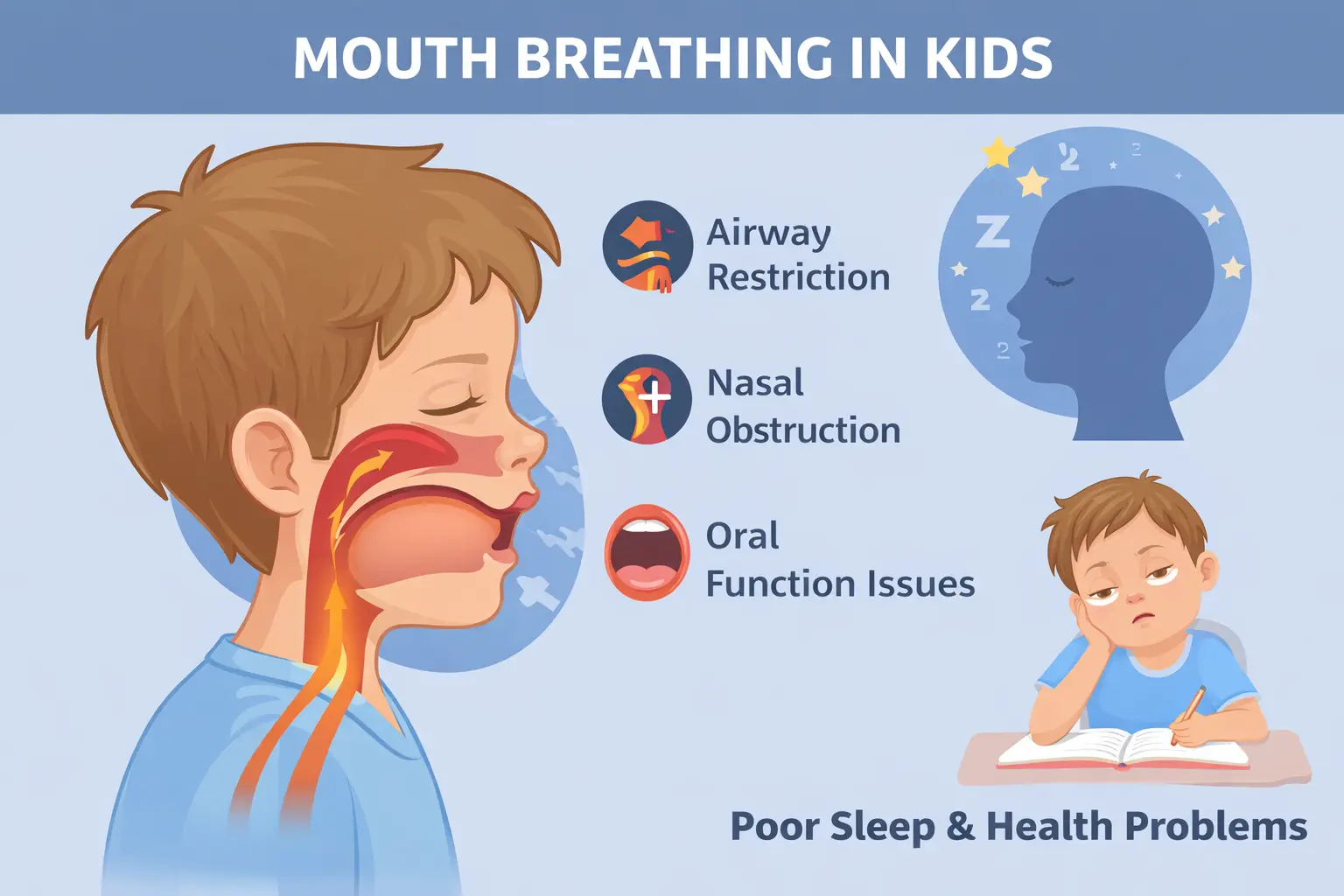

If you have ever wondered whether myofunctional therapy is just mouth exercises, you are not alone. Many parents hear the term and assume it is a small add on that cannot possibly affect big issues like sleep, speech, or development.
Pediatric myofunctional therapy is structured training for the muscles of the face, tongue, and airway. It supports how a child breathes, eats, sleeps, grows, and speaks. When those functions improve early, it can support a healthier developmental path over time.
Why parents look for answers in the first place
Most families do not start by searching for pediatric myofunctional therapy. They start by searching symptoms such as:
-
A child who snores, mouth breathes, or sleeps restlessly
-
A child who wakes up tired even after a full night in bed
-
A child who struggles to chew, eats loudly, or has messy eating habits
-
A child whose speech sounds unclear or effortful
-
A child with crowded teeth, a narrow palate, or a jaw that looks underdeveloped
These signs often feel disconnected, so families chase them one at a time. In reality, many of these concerns can share a common root: oral function and airway habits that are not developing in an ideal pattern.
What is pediatric myofunctional therapy?
Pediatric myofunctional therapy is a guided program that trains the muscles of the tongue, lips, cheeks, and jaw to function in healthier patterns. It is often compared to physical therapy for the face and airway because it focuses on coordination, strength, and habit formation. The goal is not to force change. The goal is to help the body learn more efficient patterns for daily function such as breathing, chewing, swallowing, and resting posture.
Myofunctional therapy helps a child build healthier breathing and oral habits by training the muscles that shape how the mouth and airway work every day and every night.
Why tongue posture and breathing patterns matter for growth
A child is developing every day. The way they breathe and hold their tongue at rest can influence how the mouth, palate, and jaw develop over time.
When a child is breathing through the mouth, the lips are often open and the tongue often rests low. Over time, that pattern can reduce the natural support the tongue can provide to the upper jaw and palate. This can affect:
-
Space for teeth
-
Oral function efficiency
-
Airway stability during sleep
Nasal breathing supports healthier breathing mechanics. It also supports filtration and humidification of the air, which can be helpful for comfort and sleep quality. Myofunctional therapy focuses on improving these patterns through guided training and habit reinforcement.
What myofunctional therapy actually trains
Pediatric myofunctional therapy is not random drills. It targets specific functions that influence comfort and development.
Tongue posture at rest
A functional tongue rest posture typically includes the tongue positioned up against the palate with lips closed and nasal breathing when possible. This supports:
-
Balanced oral muscle tone
-
Healthier facial growth patterns over time
Lip seal and oral muscle balance
If a child cannot maintain a comfortable lip seal, the mouth stays open more often, especially during sleep. Therapy supports:
-
Muscle balance
-
Awareness of resting posture
-
Easier, more natural lip closure
Nasal breathing habits
Many kids mouth breathe out of habit or because something is making nasal breathing difficult. Therapy can support:
-
Nasal breathing pattern reinforcement
-
Collaboration with other providers when structural barriers are present
Swallowing mechanics
Some children develop a tongue thrust pattern where the tongue pushes forward against or between the teeth during swallowing. Therapy helps train:
-
More functional swallowing mechanics
-
Improved coordination and stability
Chewing and feeding skills
Chewing is a coordinated skill that requires strength, timing, and control. Therapy can support:
-
More effective chewing
-
Calmer eating habits
-
Better tolerance for a variety of textures
Speech support through function
Myofunctional therapy is not speech therapy, but functional tongue placement and lip stability can support speech clarity. Many families report improved clarity when:
-
Oral posture becomes more consistent
-
Muscle coordination improves
What benefits can myofunctional therapy support?
Myofunctional therapy does not promise cures. Outcomes vary based on the child, consistency, and whether other factors need to be addressed. Many families pursue therapy because they want to support foundational functions that influence daily life.
Parents commonly hope to support improvements in:
-
Sleep quality and nighttime breathing patterns
-
Nasal breathing and reduced mouth breathing
-
Tongue posture awareness and stability
-
Chewing coordination and quieter, cleaner eating
-
Swallow function and oral muscle balance
-
Speech clarity support through functional placement
-
Jaw and palate development support during growth
-
Orthodontic stability when paired with airway focused treatment planning
Signs your child may need an evaluation
If your child has several of the signs below, it may be worth exploring a pediatric myofunctional evaluation.
Breathing and sleep signs
-
Does your child sleep with an open mouth?
-
Does your child snore even occasionally?
-
Does your child drool on the pillow or grind teeth at night?
-
Does your child wake tired or seem restless during sleep?
-
Does your child have dark circles or daytime fatigue even with a full night in bed?
Eating and oral function signs
-
Does your child chew with the mouth open?
-
Does your child eat loudly or messily?
-
Does your child avoid chewy foods or certain textures?
-
Does your child gag easily or swallow without chewing enough?
-
Does your child push the tongue forward during swallowing?
Speech and development signs
-
Does your child have unclear speech that seems effortful?
-
Is the tongue visible between the teeth during speech?
-
Does your child have crowded teeth or a narrow palate?
-
Does your child often rest with lips open in photos?
-
Does your child have a forward head posture or low tongue posture patterns?
These signs are not a diagnosis. They are signals that a functional evaluation could help clarify what is happening.
What to expect during a pediatric myofunctional therapy program
A high quality program is structured, guided, and personalized.
A typical process includes:
-
A comprehensive evaluation of breathing, tongue posture, oral rest posture, swallowing, and oral function
-
A plan that matches your child’s age, maturity, and needs
-
Therapist guided sessions to ensure correct form and progress
-
Home practice that is realistic and consistent
-
Progress check ins to adjust and advance the plan
-
Collaboration with other providers when needed
Many children benefit most when the care team works together. Depending on the child, co management may include:
-
Dental providers
-
Orthodontic providers
-
Ear nose and throat specialists
-
Sleep providers
-
Speech language pathology
Why early intervention can matter
Early intervention works with growth. A child is still developing habits, muscle coordination, and airway function. Supporting healthier patterns earlier can help reduce compensation patterns that become harder to change later.
Parents often explore pediatric myofunctional therapy because they want to support:
-
Better sleep and more stable nighttime breathing
-
Improved daily energy and focus linked to sleep quality
-
More efficient eating and improved comfort during meals
-
Healthier oral posture habits that support growth
-
Better stability for orthodontic outcomes when treatment is appropriate
Pediatric myofunctional therapy is guided muscle training that supports tongue posture, nasal breathing, swallowing, chewing, and oral rest posture. It is often used to support better sleep and healthier airway and jaw development patterns during childhood.
Key takeaways
-
Myofunctional therapy addresses how a child breathes, rests, chews, and swallows
-
Tongue posture and mouth breathing habits can influence development over time
-
Many parents notice changes in sleep and eating as function improves
-
A structured program includes guided visits and realistic home practice
-
Early support works with a child’s growth and habit formation
Who is it for?
Children who mouth breathe, snore, have restless sleep, struggle with chewing and swallowing, show tongue thrust patterns, or have signs of narrow palate and crowded teeth may benefit from an evaluation.
Frequently asked questions
Is myofunctional therapy just mouth exercises?
No. It is a structured program that trains tongue posture, nasal breathing patterns, swallowing mechanics, and oral muscle coordination that influence sleep, eating, speech support, and development.
What age is best for pediatric myofunctional therapy?
Many children can start when they are able to follow directions and practice consistently. A consultation can help determine readiness and the right timing based on development and symptoms.
Can myofunctional therapy help with mouth breathing in kids?
It can support healthier breathing habits by training oral posture and muscle function. If there are nasal airway barriers, collaboration with other providers may be needed.
Can myofunctional therapy help with sleep quality?
It may support sleep quality by encouraging nasal breathing and healthier oral posture patterns during rest. Results vary and depend on individual factors.
Can myofunctional therapy replace braces or orthodontics?
It is not a replacement. It can support functional stability and healthy habits that may improve long term outcomes, especially when combined with airway focused orthodontic planning when appropriate.
How long does pediatric myofunctional therapy take?
Programs vary based on the child’s needs, consistency, and whether other factors are involved. Many families see progress over weeks and months, with long term habit support as the goal.
What should I do if my child snores?
Snoring can be a sign of restricted airflow during sleep. A consultation can help evaluate breathing patterns, oral posture, and next steps for a collaborative plan.
Book your free consultation
Book your free consultation in under 5 minutes.
https://mychart.myoryx.com/patient/#/auth/onlineschedule?realm=myoway&univers=com