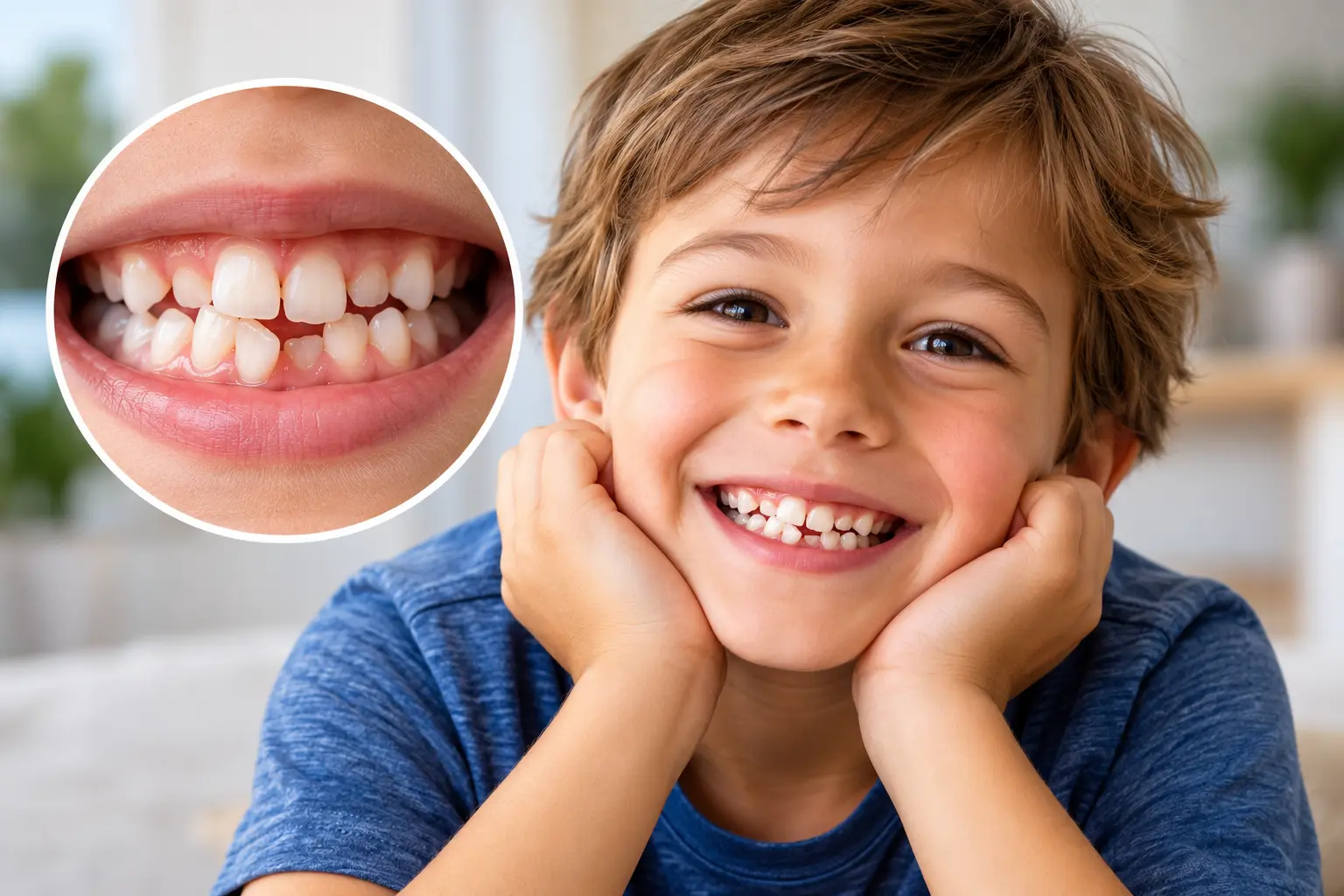
Many parents are told their child has crowded teeth, a narrow palate, or a small jaw. Most of the time, the explanation sounds simple: genetics.
Genetics may play a role, but it may not tell the whole story. Modern children are growing up in a very different environment than the one the human jaw was originally designed for.
Today’s children often eat softer foods, chew less, breathe through the mouth more often, and spend more time with the tongue resting low instead of against the roof of the mouth. Over time, these patterns may influence how the jaw, palate, tongue, and airway develop.
This is part of what we mean by the shrinking human face. The human face has changed over time. Modern jaws are often smaller and less developed than the jaws of ancestral populations. At the same time, children still need enough room for their teeth, tongue, nasal airway, and healthy oral function.
When the jaw does not develop with enough width or forward growth, the result may be more than crowded teeth. It may affect breathing, sleep, focus, behavior, and long-term airway development.
At MyoWay Centers for Kids, we believe crowded teeth should not be viewed only as a tooth alignment issue. Crowding may also be a visible sign that a child does not have enough room for the teeth, tongue, and airway to function well together.
This is why early evaluation matters. The question is not only, “How do we straighten the teeth later?” The better question is, “Why is there not enough room now?”
What Is the Shrinking Human Face?
The shrinking human face refers to the idea that modern jaws and facial structures are often developing smaller than they did in earlier human populations.
This does not mean every child has the same growth pattern. It also does not mean every case of dental crowding or mouth breathing has one simple cause. Jaw development is influenced by genetics, environment, muscle function, breathing patterns, diet, sleep, and oral posture.
Tooth size is strongly influenced by genetics. Jaw growth, however, is also shaped by function. The way a child breathes, chews, swallows, rests the tongue, and sleeps can all influence the growth environment of the face.
When children chew less, breathe through the mouth, or rest the tongue low in the mouth, the jaw and palate may not receive the same natural growth signals that supported stronger facial development in earlier generations.
This creates an evolutionary mismatch. A child may still have the genetic blueprint for a full set of adult teeth, while the jaw may not develop enough space to hold those teeth comfortably.
That mismatch can show up as crowded teeth, narrow arches, mouth breathing, restless sleep, and concerns related to airway development.
Why the Modern Jaw May Be an Evolutionary Mismatch
For most of human history, children ate foods that required more effort from the jaw and facial muscles. Tougher, more fibrous foods created daily mechanical stimulation for the developing jaws.
Modern diets are very different. Many children now eat foods that require far less chewing, including soft breads, pastas, pouches, refined snacks, smoothies, and processed foods that break down quickly in the mouth.
Soft foods are not automatically bad, and parents should not feel guilty for using convenient foods when needed. The concern is that many children may not be getting enough chewing challenge throughout the day to help stimulate healthy jaw growth.
The jaw is designed to respond to function. When the muscles of the mouth and face are used well, they provide important input to the bones that are still growing. When that input is reduced, the growth environment changes.
This is one reason many children can have teeth that are normal in size, yet jaws that do not provide enough room.
In other words, the teeth may not be too big. The jaw may be too underdeveloped for the teeth, tongue, and airway.
Dental Crowding Is Not Just a Tooth Problem
Crowded teeth are often viewed as a cosmetic or orthodontic issue. In reality, crowding can tell us something important about development.
When there is not enough room for the teeth, there may also be limited room for the tongue. When the tongue does not have enough space, it may rest low in the mouth or fall backward during sleep. This can affect oral posture, breathing, and airway stability.
A child with crowded teeth may also have a narrow palate, low tongue posture, mouth breathing, reduced nasal breathing comfort, poor lip seal, restless sleep, snoring, or bite concerns.
This does not mean every child with crowded teeth has an airway issue. It does mean crowded teeth should prompt a deeper conversation about growth, breathing, and oral function.
At MyoWay Centers for Kids, we encourage families to look beyond the teeth alone. Crowding is often the first visible sign that the mouth may not have developed enough space for normal function.
Why the Tongue Matters in Jaw Development
The tongue is not just for speech and swallowing. It is also an important part of jaw and palate development.
At rest, the tongue should ideally sit gently against the roof of the mouth. This tongue to palate contact provides natural internal support for the upper jaw as a child grows.
When the tongue rests low in the mouth, the palate may not receive the same support. Over time, this may contribute to a narrower upper jaw, reduced tongue space, and a greater likelihood of mouth breathing.
Healthy tongue posture supports nasal breathing, lip seal, swallowing coordination, jaw stability, airway function, and oral muscle balance.
This is why pediatric myofunctional therapy can be so valuable. It helps children build healthier oral muscle patterns that support proper tongue posture, nasal breathing, and better function.
From a developmental perspective, oral posture is not passive. The resting position of the tongue, lips, and jaw can help shape the environment in which the face grows.
How Mouth Breathing Can Affect the Modern Jaw
Mouth breathing in kids is not just a habit.
When a child breathes through the mouth, the lips are often apart and the tongue rests low. This changes the resting posture of the mouth and face. Over time, mouth breathing may be associated with narrow palate development, crowded teeth, dry mouth, restless sleep, snoring, low tongue posture, poor lip seal, and reduced comfort with nasal breathing.
Nasal breathing matters because it helps support better oral posture. When the lips are closed and the tongue rests against the palate, the mouth is in a healthier resting position. When nasal breathing feels difficult, a child may compensate by breathing through the mouth.
That compensation can become a pattern, especially during sleep.
The earlier mouth breathing is identified, the better chance families have to support healthier function while the child is still growing.
The Connection Between Jaw Development, Sleep, and Behavior
A child with airway or jaw development concerns may not always look tired.
Children often respond to poor sleep differently than adults. Instead of acting sleepy, they may become more active, emotional, impulsive, or distracted.
Parents may notice snoring, restless sleep, mouth breathing during sleep, teeth grinding, bedwetting, frequent waking, sweating during sleep, morning moodiness, trouble focusing, hyperactivity, emotional outbursts, or difficulty waking up.
These signs do not confirm a diagnosis. They are signals that sleep, breathing, airway development, and oral function may need to be evaluated together.
At MyoWay Centers for Kids, we encourage parents to look at the full pattern, not just one symptom. A child who snores, mouth breathes, grinds their teeth, and struggles with focus may not have four separate concerns. Those signs may be connected through airway development and sleep quality.
This is why the shrinking human face is not only an orthodontic conversation. It is also a breathing, sleep, growth, and development conversation.
Why Early Evaluation Matters
The preschool and early elementary years are an important time for jaw and airway development.
During these years, the face, palate, jaws, dental arches, nasal airway, and oral muscles are still developing. This creates an opportunity to identify concerns early and support healthier growth patterns.
Waiting until all the adult teeth come in may mean waiting until the foundational growth pattern has already been established. At that point, treatment may focus more heavily on tooth alignment rather than the developmental environment that contributed to the crowding in the first place.
Early evaluation can help identify concerns such as narrow palate development, crowded teeth, mouth breathing, poor tongue posture, poor lip seal, snoring, restless sleep, oral muscle dysfunction, chewing concerns, swallowing concerns, and airway development signs.
The goal of early evaluation is not to create fear. The goal is to give parents clarity.
When families understand what is happening early, they may have more options to support their child’s growth.
How Pediatric Myofunctional Therapy Supports Jaw and Airway Development
Pediatric myofunctional therapy focuses on the muscles of the mouth, face, tongue, and airway. These muscles influence how a child breathes, rests, chews, swallows, and sleeps.
If the lips are always open, the tongue rests low, or swallowing patterns are not well coordinated, the child’s growth environment may be affected over time.
Myofunctional therapy helps support nasal breathing, proper tongue posture, lip seal, tongue to palate contact, functional swallowing, jaw stability, oral muscle coordination, and better rest posture.
At MyoWay Centers for Kids, pediatric myofunctional therapy is part of a larger airway centered approach. We look at how structure and function work together because a child may need support with both jaw development and oral muscle patterns.
When structure and function are addressed together, the child has a better foundation for breathing, sleeping, and growing.
The Role of Early Orthodontics and Guided Growth
Traditional orthodontics often focuses on straightening teeth after crowding has already developed.
Early airway centered care asks a different question. Instead of only asking how to align the teeth later, we ask why the teeth do not have enough room now.
Early orthodontics and guided growth approaches may help support palate width, dental arch development, tongue space, nasal breathing support, jaw growth patterns, airway foundation, and oral function.
The goal is not just a straighter smile. The goal is to create enough room for the teeth, tongue, and airway to work together.
When children are still growing, there may be an opportunity to guide development before restriction becomes more difficult to address.
Take the Sleep Related Breathing Disorder Quiz
If you are wondering whether your child’s breathing, sleep, focus, or jaw development could be connected, the Sleep Related Breathing Disorder Quiz on the MyoWay Centers for Kids website is a simple place to start.
The quiz can help parents identify signs that may be related to airway development, oral function, and sleep quality. It may be helpful if your child mouth breathes, snores, sleeps restlessly, grinds their teeth, has crowded teeth, has a narrow palate, keeps their mouth open at rest, struggles with focus, wakes up tired, or has frequent emotional outbursts.
Taking the quiz is not a diagnosis. It is a parent-friendly tool that can help you recognize patterns worth discussing with an airway focused provider.
How MyoWay Centers for Kids Helps
At MyoWay Centers for Kids, we take a comprehensive approach to pediatric airway development. We look beyond teeth alone.
Our evaluations may consider jaw development, palate shape, dental arch width, tongue space, tongue posture, lip seal, nasal breathing, mouth breathing patterns, sleep quality, oral muscle function, chewing and swallowing patterns, and airway development signs.
This helps us understand whether a child’s structure and function are supporting healthy growth.
Our approach may include pediatric myofunctional therapy, medical grade appliances, airway focused development, and collaboration with other healthcare providers when appropriate.
The goal is to support breathing, sleep, oral function, jaw development, and growth during the years when the child is most adaptable.
Why This Matters for Parents
Parents are often told to wait and see. Wait until the adult teeth come in. Wait until the child is older. Wait until braces are needed.
When it comes to airway development, waiting is not always the best answer.
Children are growing now. Their jaws, palates, muscles, habits, and breathing patterns are developing every day. Early signs can be easy to miss, especially when they seem unrelated.
A child who snores may also have crowded teeth. A child who mouth breathes may also struggle with focus. A child with a narrow palate may also sleep restlessly. A child who grinds their teeth may also have low tongue posture.
When these patterns are viewed together, parents can make more informed decisions.
The shrinking human face is not about blaming parents or creating worry. It is about recognizing that modern children may need different support because they are growing in a different environment.
Key Takeaways
The shrinking human face is an important concept because it helps explain why many modern children have crowded teeth, smaller jaws, narrow palates, and airway related concerns.
Modern jaw development may be influenced by softer diets, less chewing, mouth breathing, low tongue posture, poor lip seal, and sleep related breathing patterns. These factors may reduce the functional input children need for healthy jaw and airway development.
Dental crowding should not only raise the question, “When will my child need braces?” It should also raise the question, “Does my child have enough room for the teeth, tongue, and airway to function well?”
The goal is not only to create room for teeth. The goal is to create room for breathing, sleeping, growing, and thriving.
Frequently Asked Questions
What is the shrinking human face?
The shrinking human face refers to the idea that modern jaws and facial structures are often developing smaller than they did in earlier human populations. This may be influenced by softer diets, less chewing, mouth breathing, low tongue posture, and changes in childhood oral function.
Why is the modern jaw considered an evolutionary mismatch?
The modern jaw may be considered an evolutionary mismatch because children still need room for their teeth, tongue, and airway, while modern habits may not provide the same growth stimulation that ancestral diets and breathing patterns once provided.
Can soft foods affect jaw development?
Soft foods may reduce the amount of chewing effort a child uses each day. Chewing provides mechanical stimulation for the jaw and facial muscles. When children do not chew enough challenging textures, the jaw may receive less growth input.
Is dental crowding only genetic?
Dental crowding can be influenced by genetics, but it may also be affected by jaw development, oral posture, tongue space, breathing patterns, and chewing function. Crowding can be a sign that the jaws did not develop enough room for the teeth.
Can mouth breathing affect a child’s jaw?
Mouth breathing may affect tongue posture, lip seal, palate development, and jaw growth patterns. When the mouth stays open and the tongue rests low, the upper jaw may not receive the same natural support during growth.
What does the tongue have to do with jaw development?
The tongue helps support the palate when it rests properly against the roof of the mouth. Healthy tongue posture can support palate development, nasal breathing, and oral muscle balance.
What are signs my child may need an airway evaluation?
Signs may include mouth breathing, snoring, restless sleep, teeth grinding, crowded teeth, narrow palate, open mouth posture, trouble focusing, hyperactivity, emotional outbursts, and waking up tired.
What is pediatric myofunctional therapy?
Pediatric myofunctional therapy supports healthier oral muscle function. It encourages nasal breathing, proper tongue posture, lip seal, functional swallowing, and better oral rest posture.
What is the Sleep Related Breathing Disorder Quiz?
The Sleep Related Breathing Disorder Quiz on the MyoWay Centers for Kids website is a parent-friendly tool that helps identify signs that may be connected to breathing, sleep quality, airway development, and oral function. It is not a diagnosis, but it can help families decide whether an airway focused evaluation may be helpful.
When should parents schedule an evaluation?
Parents should consider an airway focused evaluation if their child mouth breathes, snores, sleeps restlessly, grinds teeth, has crowded teeth, has a narrow palate, struggles with focus, or seems tired despite getting enough sleep.
The shrinking human face is more than an orthodontic observation. It is a developmental signal.
Small jaws can create big questions. Why are the teeth crowded? Why is the child mouth breathing? Why is sleep restless? Why is focus difficult? Why does the child seem tired, wired, or emotionally reactive? The answer may not be one single issue. It may be the relationship between jaw development, airway function, oral posture, and sleep.
At MyoWay Centers for Kids, we believe early evaluation can help families understand the connection between jaw development, breathing, sleep, and oral function.
Take the Sleep Related Breathing Disorder Quiz on the MyoWay Centers for Kids website to see whether your child may benefit from an airway focused evaluation.
Book your free consultation in under 5 minutes.
https://mychart.myoryx.com/patient/#/auth/onlineschedule?realm=myoway&univers=com