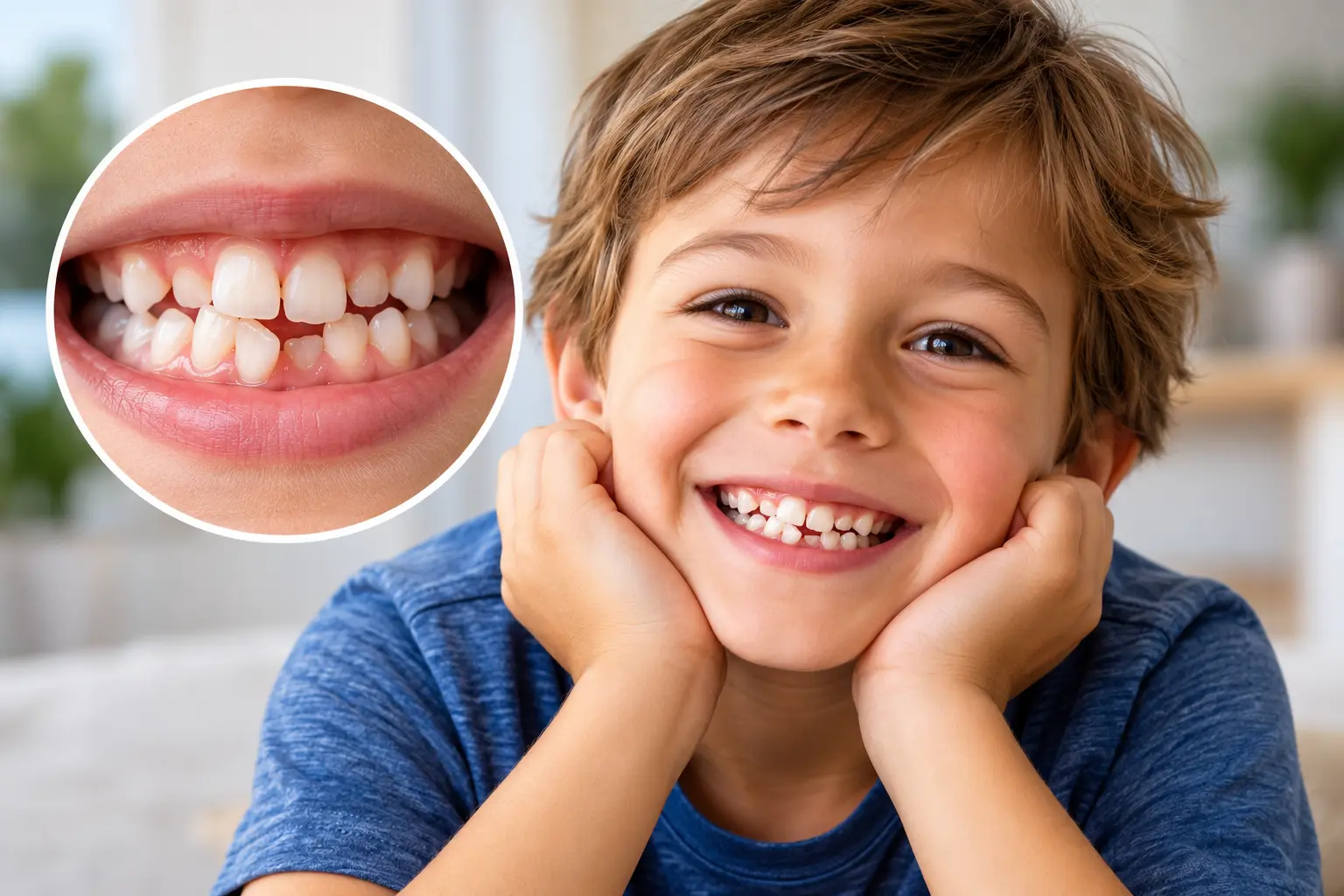


A child sitting quietly with their lips apart may not seem concerning. Parents often assume the child is distracted, congested, tired, or simply has a habit of leaving the mouth open. In some cases, that explanation may be correct. In others, an open-mouth resting posture can be an early clue that breathing, tongue posture, lip strength, jaw development, or sleep deserves a closer look.
In clinical practice, I rarely evaluate open-mouth posture as an isolated symptom. I look at the whole pattern. Can the child breathe comfortably through the nose? Where does the tongue rest? Are the lips able to close without strain? Does the child snore, grind their teeth, sleep restlessly, or wake up tired? Is there enough room for the tongue and developing teeth?
These questions matter because the muscles of the tongue, lips, cheeks, and jaw are active throughout childhood. Their resting positions and repeated movements may influence how the mouth functions as a child grows.
An open mouth does not diagnose an airway disorder or guarantee that a child will develop orthodontic or sleep problems. It is simply a visible sign that may justify a thoughtful evaluation.
Persistent open-mouth posture in a child may indicate difficulty with nasal breathing, low tongue posture, limited lip seal, oral muscle coordination concerns, or developing dental and jaw relationships. It does not diagnose a sleep or airway disorder, but an evaluation can help identify contributing factors.
What Is Open-Mouth Resting Posture?
Open-mouth resting posture means that a child’s lips remain separated when the child is not speaking, eating, exercising, or intentionally breathing through the mouth.
Parents may notice it while their child is:
- Watching television
- Reading or doing homework
- Riding in the car
- Using a tablet
- Sleeping
- Sitting quietly
- Playing without strenuous activity
Occasional open-mouth posture is not necessarily unusual. A child may temporarily breathe through the mouth during a cold, after physical activity, or when nasal congestion makes breathing uncomfortable.
The concern is a consistent pattern, especially when the child appears unable to maintain comfortable lip closure or regularly relies on mouth breathing during quiet activities and sleep.
Open-mouth posture and mouth breathing often occur together, but they are not exactly the same. Some children hold their lips apart while still moving at least some air through the nose. Others alternate between nasal and oral breathing. A complete assessment looks beyond the appearance of the lips and evaluates how the child is actually breathing and functioning.
Parents who want a deeper explanation of possible causes can read What Is Really Behind Pediatric Mouth Breathing?.
Why Might a Child Keep Their Mouth Open?
There is rarely one universal explanation. Open-mouth posture can develop from a combination of structural, muscular, respiratory, sensory, and behavioral factors.
Nasal breathing may feel difficult
A child may open the mouth because airflow through the nose feels limited. Possible contributors include allergies, chronic congestion, enlarged tonsils or adenoids, inflammation, nasal anatomy, or an acute illness.
The child may not describe the sensation as difficulty breathing. Younger children often adapt without realizing they are compensating. Mouth breathing may simply become the easiest available way to move air.
This is why telling a child to “close your mouth” is not always helpful. Before expecting consistent lip closure, it is important to determine whether nasal breathing is comfortable and medically appropriate.
The lips may lack endurance or coordination
Some children can close their lips briefly but cannot maintain a relaxed lip seal. They may need to tighten the chin, strain the lower lip, or consciously hold the mouth closed.
This can indicate that the oral muscles are not working together efficiently. It does not necessarily mean the muscles are generally weak. The issue may involve coordination, resting posture, breathing demand, or the relationship between the lips, teeth, jaws, and tongue.
The tongue may rest low in the mouth
At rest, the tongue normally occupies space within the oral cavity and typically rests upward rather than lying heavily on the floor of the mouth. A child who regularly keeps the mouth open may also develop a low tongue-resting posture.
The relationship can work in both directions. Difficulty breathing through the nose may lead the child to lower the tongue and open the mouth. Repeating that posture may then make the open-mouth pattern more familiar and automatic.
The MyoWay guide to pediatric myofunctional therapy and oral muscle training explains how tongue position, lip seal, swallowing, chewing, and breathing are assessed as connected functions rather than separate habits.
Jaw or dental relationships may make lip closure difficult
A child with prominent front teeth, a narrow dental arch, an open bite, or a smaller lower jaw may find relaxed lip closure more difficult. The lips may remain apart because of the relationship between the teeth and jaws, not because the child is refusing to close them.
Research has found associations between mouth breathing and differences in dentofacial development, including certain jaw and bite patterns. A 2021 systematic review and meta-analysis reported measurable differences between groups of mouth-breathing and nasal-breathing children. The authors also noted that the available studies varied in quality and design, so these findings should be interpreted as associations rather than proof that mouth breathing alone causes every facial or dental change. See the systematic review of mouth breathing and facial skeletal development in children.
Why Resting Posture Matters During Growth
Parents understandably focus on active functions such as speaking, chewing, and swallowing. Resting posture receives less attention, even though children spend far more time at rest than they do performing any one oral activity.
A child swallows many times during the day, but the tongue, lips, and jaw also maintain a resting position for hours. Small forces applied repeatedly may matter during growth, particularly when they are combined with breathing patterns, oral habits, dental development, and individual anatomy.
A study examining lip seal and craniofacial morphology found correlations between an incompetent lip seal, open-mouth posture, and certain craniofacial characteristics. This type of study cannot prove that one factor directly caused the other, but it supports the clinical value of evaluating posture as part of a broader functional picture. Read the study on lip seal and craniofacial growth.
In practical terms, an open mouth may tell us that the child’s oral system is adapting to something. The next step is not to assume the cause. It is to determine what the child is adapting to.
The Connection Between Open-Mouth Posture and Sleep
Parents may first notice open-mouth posture during the day, but nighttime observations often provide important context.
A child who sleeps with the mouth open may also:
- Snore or breathe noisily
- Toss and turn
- Sleep with the neck extended
- Grind the teeth
- Sweat heavily
- Wake frequently
- Experience bedwetting beyond the expected age
- Wake with dry lips or a dry mouth
- Seem difficult to wake in the morning
- Become irritable, impulsive, or unusually active during the day
None of these signs confirms obstructive sleep apnea. Snoring and open-mouth sleep can occur for several reasons, and children require an appropriate medical evaluation when a sleep-related breathing disorder is suspected.
The American Academy of Pediatric Dentistry recognizes that obstructive sleep apnea occurs in children and encourages health professionals to screen for increased risk and facilitate medical referral when indicated. Its policy notes that pediatric obstructive sleep apnea differs from the adult condition and may be associated with disrupted sleep, learning concerns, behavioral problems, and impaired growth when it remains undiagnosed or untreated. Parents can review the American Academy of Pediatric Dentistry policy on pediatric obstructive sleep apnea.
A child with an open mouth does not automatically have sleep apnea. However, open-mouth posture combined with frequent snoring, pauses in breathing, gasping, labored breathing, or significant daytime symptoms should not be dismissed as merely a habit.
Why “Just Close Your Mouth” Is Not a Complete Solution
Many parents have tried reminders, sticker charts, chin straps, mouth tape, or repeated instructions to encourage closed lips. The frustration is understandable. The mouth opens again because the underlying reason has not been identified.
A child should not be forced to keep the mouth closed when nasal breathing is difficult. Mouth taping is not an appropriate substitute for airway assessment, particularly in a child who snores, has chronic congestion, struggles to breathe through the nose, or has not been medically evaluated.
Even when the nasal airway is clear, reminders alone may not change a deeply established pattern. The child may need help developing awareness, coordination, tongue posture, lip endurance, or a more functional swallowing pattern.
The goal is not to make the lips appear closed for a photograph. The goal is comfortable, sustainable function.
What a Thorough Evaluation Should Consider
An open-mouth posture evaluation should involve more than observing whether the lips touch. Depending on the child’s signs and history, several professionals may contribute useful information.
A comprehensive assessment may consider:
Breathing route
The provider may observe whether the child can breathe comfortably through the nose at rest. A medical evaluation may be appropriate when allergies, congestion, enlarged tonsils or adenoids, or another obstruction is suspected.
Tongue-resting position
The evaluation may examine where the tongue rests, whether it has enough space, and whether the child can elevate it comfortably.
Lip seal
The provider may determine whether the lips close naturally or whether the child strains the chin and facial muscles to maintain closure.
Swallowing and chewing
A forward tongue movement, messy chewing, prolonged mealtimes, limited food textures, or difficulty coordinating the mouth can provide additional information about oral function.
Jaw and dental development
The width of the dental arches, the child’s bite, tooth crowding, palate shape, and the relationship between the upper and lower jaws may influence resting posture.
Sleep and daytime behavior
Snoring, restless sleep, nighttime waking, morning headaches, fatigue, poor concentration, emotional changes, and hyperactivity may help determine whether a sleep assessment or medical referral is needed.
MyoWay’s Conditions We Treat page outlines the range of breathing, sleep, oral muscle, dental, feeding, and habit concerns that may be considered during an evaluation.
How Myofunctional Therapy May Help
Myofunctional therapy is a structured approach to improving patterns involving the tongue, lips, cheeks, jaw, swallowing, and breathing. For a child with open-mouth posture, therapy may focus on:
- Building awareness of resting posture
- Supporting comfortable lip closure
- Improving tongue mobility and coordination
- Establishing a more functional tongue-resting position
- Encouraging nasal breathing when the airway is clear
- Retraining swallowing patterns
- Improving consistency through age-appropriate home practice
Therapy should be individualized. A child whose mouth is open because of nasal obstruction needs a different plan from a child whose airway is clear but whose oral posture has remained unchanged after years of compensation.
Research into myofunctional therapy for children with sleep-related breathing disorders is promising but still developing. A systematic review of pediatric obstructive sleep apnea found potential benefits, while also emphasizing limitations in the number and quality of available studies. Myofunctional therapy should therefore be viewed as one possible part of multidisciplinary care, not as a guaranteed or universal treatment for sleep apnea. See the systematic review of myofunctional therapy in children with obstructive sleep apnea.
Why Orthodontic and Myofunctional Care May Work Together
Some children have both functional and structural concerns. The tongue may rest low, the lips may remain apart, and the jaws may not provide enough room for comfortable oral function.
Orthodontic treatment can address dental alignment and, when clinically appropriate, guide aspects of jaw or dental arch development. Myofunctional therapy addresses how the muscles function within that structure.
Neither field should automatically replace the other. A child may need orthodontic care without myofunctional therapy, myofunctional therapy without orthodontic treatment, or coordinated care involving both. An ear, nose, and throat physician, pediatrician, allergist, sleep physician, speech-language pathologist, or other professional may also need to participate.
At MyoWay, the clinical objective is to examine form and function together. Creating more space does not automatically teach the tongue and lips how to use that space. Similarly, exercises cannot remove a physical obstruction or correct every structural concern.
Families can review MyoWay’s age-based myofunctional therapy and orthodontic support programs to understand how care may be adapted to a child’s developmental stage and clinical needs.
What Parents Can Observe at Home
Parents do not need to diagnose their children. They can, however, collect useful observations.
Notice your child during quiet activities. Are the lips usually together or apart? Does your child breathe quietly through the nose, or can you hear breathing from across the room? Does the chin tighten when the lips close?
Observe sleep without repeatedly waking the child. Listen for snoring, gasping, pauses, heavy breathing, or frequent position changes. Notice whether the child sleeps with the neck extended or wakes with a dry mouth.
Pay attention to patterns rather than one isolated night. Congestion during a cold is different from an open-mouth posture that occurs most days for several months.
A short video of sleep may be useful to share with the child’s pediatrician or another qualified professional. A recording cannot diagnose a sleep disorder, but it may help the provider understand what the family is observing.
Seek prompt medical guidance when a child appears to stop breathing, gasps during sleep, struggles visibly for air, develops bluish coloring, or experiences another urgent breathing concern.
When Should Parents Request an Evaluation?
Consider discussing open-mouth posture with a qualified professional when it is persistent or appears alongside:
- Regular snoring
- Difficulty breathing through the nose
- Chronic congestion
- Restless or disrupted sleep
- Daytime fatigue or hyperactivity
- Crowded teeth or a narrow palate
- An open bite
- A tongue-thrust swallow
- Feeding or chewing difficulties
- Speech concerns
- Frequent dry mouth
- Continued mouth breathing after tonsil, adenoid, or nasal treatment
- Orthodontic relapse or difficulty maintaining results
The purpose of an evaluation is not to frighten families or assign every symptom to the airway. It is to determine whether the posture is temporary, habitual, structural, muscular, medically driven, or connected to several factors.
Frequently Asked Questions
Is it normal for a child’s mouth to hang open?
An open mouth may occur temporarily during congestion, exercise, illness, or deep concentration. Persistent open-mouth posture during quiet activities or sleep may indicate difficulty with nasal breathing, lip seal, tongue posture, jaw relationships, or oral muscle coordination. An evaluation can help determine what is contributing to the pattern.
Does an open mouth mean my child has sleep apnea?
No. Open-mouth posture alone does not diagnose obstructive sleep apnea. It can, however, be one sign considered alongside snoring, gasping, breathing pauses, restless sleep, unusual sleeping positions, morning fatigue, and daytime behavioral changes.
Can my child simply learn to keep their lips closed?
Some children benefit from posture awareness and muscle training, but others cannot comfortably maintain lip closure until congestion, airway limitations, dental relationships, or structural concerns are addressed. The cause should be evaluated before relying on repeated reminders.
Can mouth breathing change a child’s face?
Research has identified associations between chronic mouth breathing and certain facial, jaw, palate, and dental patterns. The relationship is complex, and genetics, airway anatomy, oral habits, muscle function, and growth all contribute. Mouth breathing should not be presented as the sole cause of every facial difference.
What type of professional evaluates open-mouth posture?
Depending on the symptoms, evaluation may involve a dentist, orthodontist, myofunctional therapist, pediatrician, ear, nose, and throat physician, allergist, sleep physician, or speech-language pathologist. Coordinated care is often useful when several factors are involved.
At what age can open-mouth posture be evaluated?
It can be observed at any age. The evaluation and recommendations should be developmentally appropriate. Young children may need support with feeding, habits, nasal breathing, or early oral posture, while older children may require more structured muscle training or coordinated orthodontic care.
Can myofunctional therapy replace orthodontic treatment?
Not necessarily. Myofunctional therapy addresses muscle patterns and oral function. Orthodontic treatment addresses dental and structural concerns. Some children benefit from one approach, while others need both as part of coordinated care.
Helping Your Child Find a More Comfortable Resting Pattern
Open-mouth posture is easy to see, but its cause may not be obvious. It can reflect a temporary blocked nose, an established breathing pattern, low tongue posture, limited lip seal, developing dental relationships, or a combination of factors.
The most helpful response is not blame or constant correction. It is curiosity.
Ask why the child’s mouth is open. Look at breathing, sleep, muscles, tongue posture, jaw development, and medical history together. When the cause is understood, the care plan can be more specific and realistic.
Parents who are concerned about persistent open-mouth posture, mouth breathing, sleep, or jaw development can schedule a free MyoWay consultation for education and guidance about appropriate next steps. A consultation does not replace diagnosis by a physician or sleep specialist when medical evaluation is needed.