When parents come into my office concerned about crowded teeth, mouth breathing, poor sleep, or jaw development, it is natural for the conversation to turn quickly to appliances. Parents want to know what their child needs, how long they will wear it, and what the appliance is supposed to accomplish.
Those are important questions. In my clinical experience, though, the appliance is rarely the whole story.
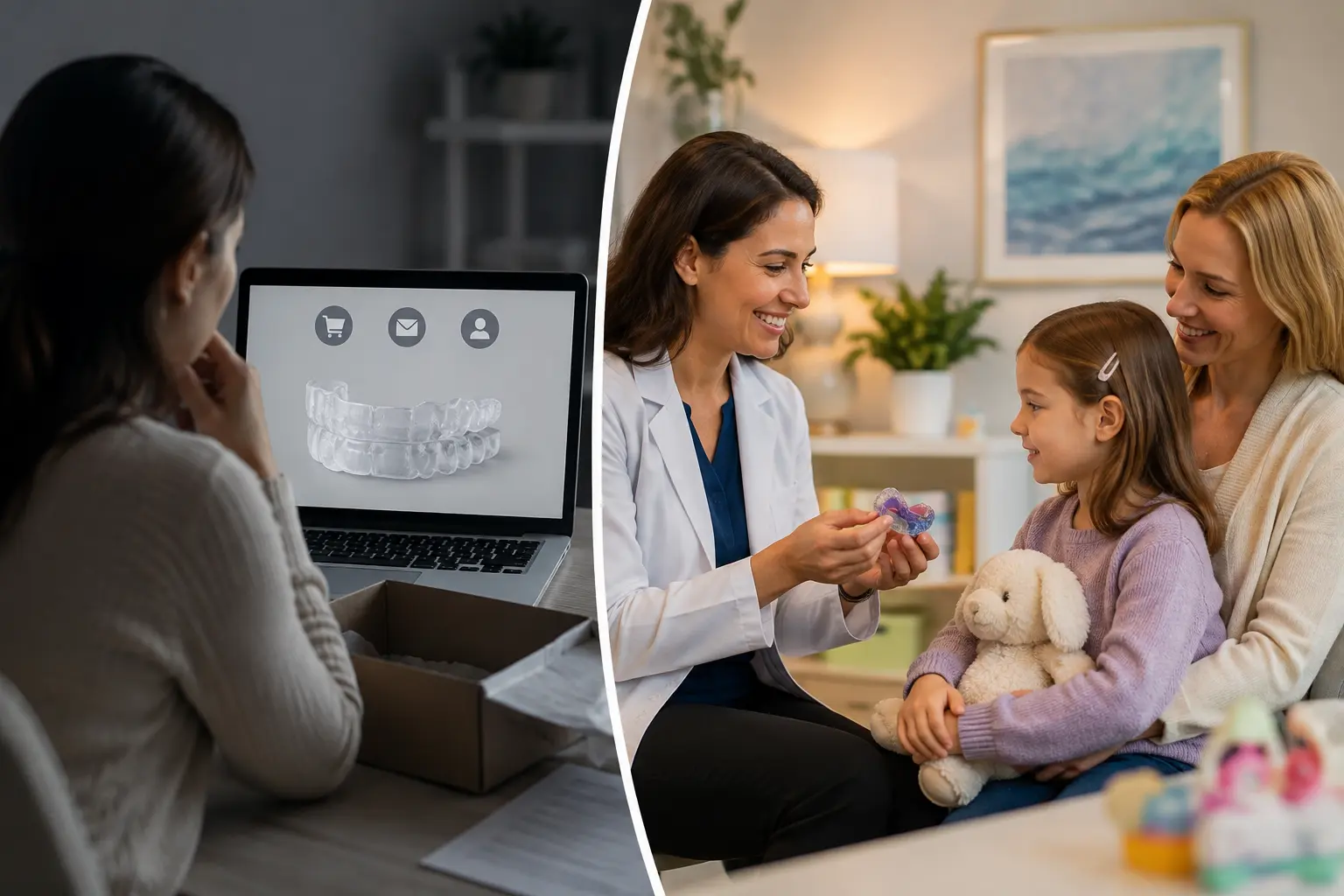
An appliance can be a useful tool during a child’s development. Depending on the child, it may help guide dental development, influence arch form, address a bite relationship, or support a specific stage of growth. What an appliance cannot do by itself is change every functional pattern happening around it.
Children breathe thousands of times a day. They swallow repeatedly, chew meals, speak, sleep, and spend hours with the tongue and lips in a resting position. Those patterns continue whether an appliance is being worn or not.
That is one of the biggest differences between an airway-first program and an appliance-only approach. Instead of focusing only on what we can place in the mouth, we also look at how the child is breathing, sleeping, swallowing, chewing, and using the muscles of the face and mouth.
At MyoWay Centers for Kids, the goal is not simply to choose an appliance. It is to understand the child more completely before deciding what kind of support may be appropriate.
An Appliance Is a Tool, Not the Entire Plan
There are many useful dental and orthodontic appliances. The appliance itself is not the problem. The more important question is whether it is being used as part of a thoughtful plan.
The American Academy of Pediatric Dentistry recommends evaluating the developing dentition in the context of the child’s dental development, oral habits, skeletal relationships, timing, and individual needs. That broader view matters because two children can have teeth that look similar while functioning very differently.
One child with crowding may breathe comfortably through the nose, sleep well, and show no obvious concerns with oral posture. Another child with similar crowding may sleep with the mouth open, snore regularly, struggle to maintain a comfortable lip seal, or rest the tongue low in the mouth.
Those children should not automatically receive identical care simply because their teeth appear similar.
This is why I encourage parents to look beyond the name of the appliance and ask what the overall program is trying to accomplish.
At MyoWay Centers for Kids, our Programs and Therapy approach considers appliances alongside myofunctional therapy, guided exercises, breathing patterns, parent education, and ongoing monitoring when those elements are appropriate for the individual child.
The key word is individual.
Not every child needs every part of the program. Some children may benefit from an appliance. Others may need more attention to oral function. Some may need medical evaluation before functional training begins. The right plan should come from what we actually find during the evaluation.
Airway-First Care Looks at Function as Well as Structure
When I evaluate a child, I am certainly looking at the teeth, bite, palate, and jaws. I am also watching how the child uses those structures.
Can the child breathe comfortably through the nose? Do the lips stay together naturally at rest? Where does the tongue sit when the child is relaxed? How does the child swallow and chew? What are parents noticing during sleep?
Those details help us understand whether we are looking at a primarily dental concern or whether a broader functional or medical issue may also be involved.
Mouth breathing is a good example.
A child may breathe through the mouth for several possible reasons. Nasal congestion, allergies, enlarged tonsils or adenoids, anatomy, illness, established breathing patterns, and oral function may all contribute. If nasal breathing is difficult, simply telling the child to close the mouth does not address the reason the pattern is happening.
We first need to understand why breathing through the nose is difficult.
Parents who are seeing chronic open-mouth posture or mouth breathing may find What Is Really Behind Pediatric Mouth Breathing? helpful for understanding some of the factors that can contribute.
The same principle applies to sleep.
Parents often tell me things they notice at night that would never be obvious during a daytime dental appointment. A child may snore, grind the teeth, move constantly during sleep, wake frequently, sleep in unusual positions, or seem tired in the morning despite spending enough hours in bed.
None of those observations creates a diagnosis by itself. They may, however, indicate that we should ask more questions.
The American Academy of Pediatric Dentistry recommends screening children for signs associated with obstructive sleep apnea and facilitating medical referral when indicated. Their policy on obstructive sleep apnea in children also recognizes that pediatric sleep-disordered breathing can have multiple contributing factors.
Regular snoring does not automatically mean a child has obstructive sleep apnea. It also should not automatically be dismissed as harmless.
When sleep symptoms are concerning, the appropriate next step may involve a pediatrician, ear, nose and throat physician, sleep physician, allergist, or another healthcare professional.
That kind of collaboration is part of airway-first thinking.
Why Function Matters During Growth
One reason I spend so much time discussing function with parents is that these patterns are repetitive.
A dental appointment happens occasionally. An exercise may take a few minutes. Breathing and resting posture happen throughout the day and night.
The tongue, lips, cheeks, and jaw also work repeatedly during swallowing, chewing, speech, and rest. That does not mean a single muscle pattern determines how a child’s face or jaws will develop. Growth is influenced by genetics, skeletal development, dental relationships, airway health, anatomy, habits, and many other factors.
Function is one part of that larger developmental environment.
This is also why I do not describe myofunctional therapy as simply a set of mouth exercises.
A structured program looks at what the child can actually do, whether nasal breathing is comfortable, how the oral muscles coordinate, how the child swallows and chews, and whether something is interfering with healthier function.
Our article Pediatric Myofunctional Therapy: More Than Just Mouth Exercises explains this difference in more detail.
A child may perform an exercise correctly for a few minutes during an appointment and still return to an open-mouth, low-tongue resting posture for most of the day. That tells us something important.
The goal is not simply to complete an exercise. The goal is to help healthier function become more consistent over time.
An appliance cannot practice that function for the child. It cannot teach a new swallowing pattern, determine why the mouth falls open at rest, or identify whether allergies, enlarged tonsils, nasal obstruction, or another medical issue is contributing to the problem.
This is where the difference between a device and a program becomes very clear.
A device has a specific mechanical purpose.
A program follows the child.
It allows us to see whether the child is adapting, whether the function is changing, whether a barrier is becoming more obvious, and whether another healthcare professional needs to become involved.
At MyoWay Centers for Kids, we consider that ongoing guidance an important part of care because children continue to grow and change throughout treatment.
Where Myofunctional Therapy Fits
Myofunctional therapy focuses on oral and facial function.
Depending on the child’s needs, therapy may work on tongue resting posture, swallowing, chewing, lip function, oral muscle coordination, and nasal breathing when nasal breathing is medically appropriate.
The goal is not perfection during an appointment. I am much more interested in whether a child can begin using healthier patterns naturally during everyday life.
Parents also deserve a realistic explanation of what myofunctional therapy can and cannot do.
Research in this area continues to evolve. Some studies suggest that orofacial muscle training may have a useful role as part of care for selected children. At the same time, myofunctional therapy should not be presented as a replacement for appropriate medical diagnosis or established treatment for pediatric obstructive sleep apnea.
A systematic review examining orthodontic management and orofacial muscle training found promising findings but also noted limitations in the quality of the available evidence.
That nuance matters.
At MyoWay Centers for Kids, airway-first care does not mean assuming every breathing, sleep, dental, or behavioral concern can be solved with an appliance or exercises.
Sometimes the most responsible recommendation is to involve another provider.
A child with significant nasal obstruction may need an ear, nose and throat evaluation. A child with allergy symptoms may need medical support. A child with concerning sleep symptoms may need evaluation by a sleep professional. Orthodontic, speech, feeding, and other concerns may also require collaboration.
Good care means understanding where our role begins and where another professional’s expertise may be needed.
The Difference Is the Thinking Behind the Program
Parents sometimes ask what makes an airway-first program different if both approaches may still use an appliance.
For me, the difference is what happens around the appliance.
We want to understand why we are using it and what we expect it to accomplish. We also want to know how the child is breathing, whether nasal breathing is comfortable, how the tongue and oral muscles are functioning, what parents are seeing during sleep, and whether another provider should be involved.
We continue watching the child as treatment progresses because children change.
They grow. Habits change. Muscle coordination develops. Symptoms may improve, stay the same, or become more noticeable. A thoughtful treatment plan should respond to what we are actually seeing instead of assuming that placing a device completes the job.
This does not mean every child needs a large or complicated program.
Some children may primarily need dental or orthodontic care. Others may benefit from myofunctional therapy. Some may need a medical evaluation first. Many children may benefit from coordinated care, while others may simply need to be monitored.
The goal of airway-first care is not to give every child more treatment.
The goal is to understand the child more completely before deciding what treatment makes sense.
That is why I encourage parents to move beyond the question, “Which appliance does my child need?”
A better question is, “What is influencing the way my child is breathing, sleeping, growing, and functioning?”
From there, we can decide whether an appliance belongs in the plan and what else may deserve attention.
If your child is mouth breathing, snoring regularly, sleeping restlessly, showing an open-mouth resting posture, or having concerns related to jaw or dental development, an evaluation can help clarify what may be contributing.
You can learn more about the types of concerns evaluated at MyoWay Centers for Kids on our Conditions We Treat page.
If you would like the team at MyoWay Centers for Kids to take a closer look at your child’s breathing, oral function, sleep, and development, you can schedule a free consultation.
Frequently Asked Questions
What is an airway-first program for children?
An airway-first program considers breathing and oral function alongside the child’s teeth, jaws, bite, and development. Depending on the evaluation, care may involve an appliance, myofunctional therapy, monitoring, medical referral, or a combination of approaches.
Is an appliance enough to stop mouth breathing?
Not always. Mouth breathing may be associated with nasal congestion, allergies, enlarged tonsils or adenoids, anatomy, established breathing patterns, and other factors. An evaluation can help determine why the child is breathing through the mouth before deciding what type of support may be appropriate.
Does every child in an airway-first program need an appliance?
No. Recommendations should be based on the individual child. Some children may benefit from an appliance, while others may need functional therapy, medical evaluation, orthodontic care, monitoring, or a different combination of support.
Can myofunctional therapy replace orthodontic treatment?
No. Myofunctional therapy and orthodontics address different aspects of care. Myofunctional therapy focuses on oral and facial function, while orthodontic treatment focuses on dental and skeletal relationships. Some children may benefit from both when functional and structural concerns occur together.
Can myofunctional therapy treat pediatric sleep apnea?
Myofunctional therapy should not be considered a replacement for appropriate medical evaluation or established treatment of pediatric obstructive sleep apnea. It may have an adjunctive role for selected children as part of coordinated care.
Why does tongue posture matter if my child already has an appliance?
An appliance works toward a particular structural or dental goal. Tongue, lip, swallowing, chewing, and breathing patterns continue throughout the day. Those functions may be worth evaluating because they are part of the child’s overall oral environment.
When should I be concerned about my child’s snoring?
Occasional snoring during an illness can happen. Regular snoring, especially when it occurs with restless sleep, pauses in breathing, gasping, daytime tiredness, difficulty waking, or behavioral changes, is worth discussing with an appropriate healthcare professional.
How is MyoWay Centers for Kids different from an appliance-only program?
MyoWay Centers for Kids looks beyond the appliance itself. The program considers breathing, oral posture, swallowing, chewing, sleep, jaw development, and other functional patterns alongside structural needs. Appliances may be one part of care, but they are used within a broader evaluation and ongoing program rather than as the entire approach.