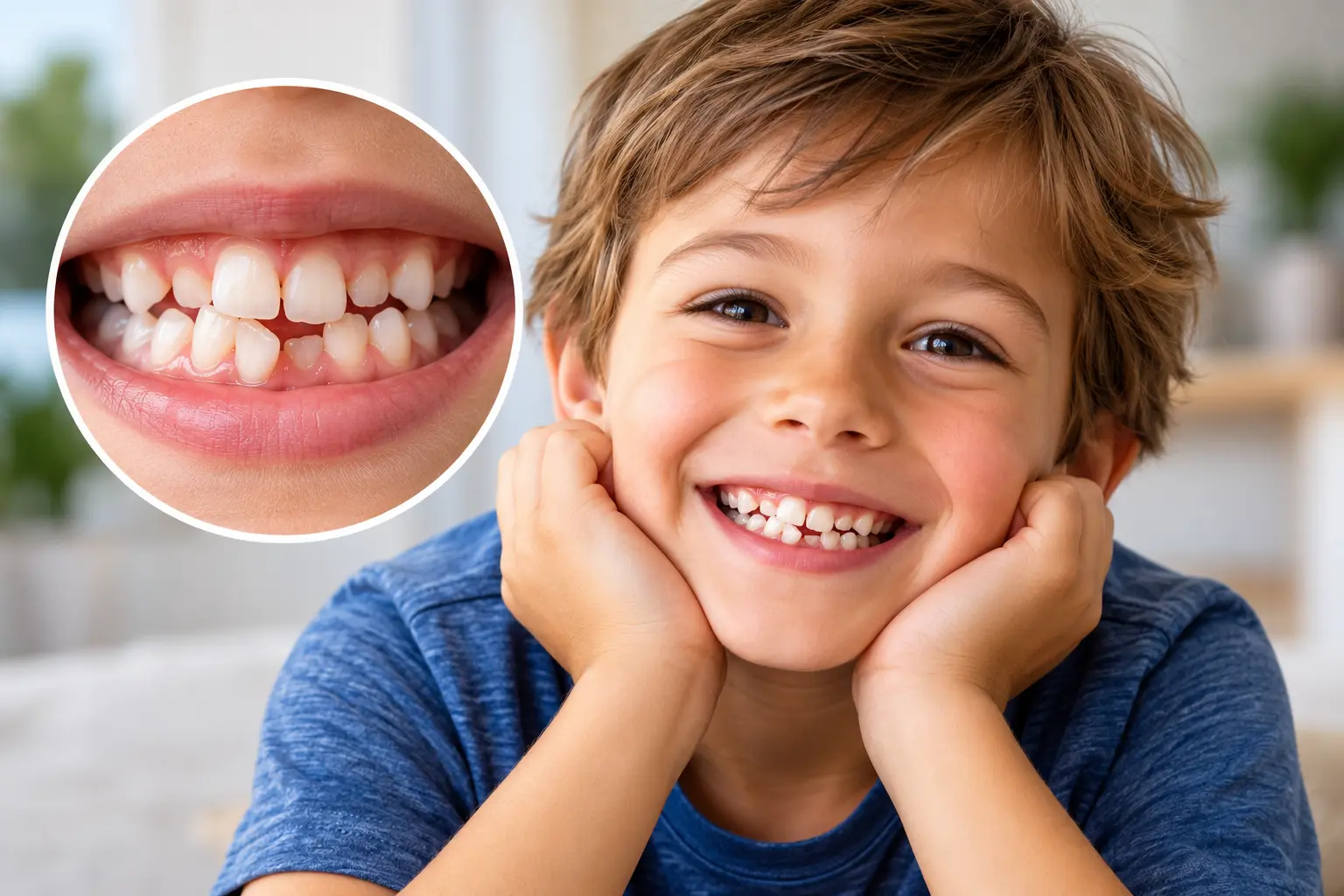

Your child loses a front baby tooth, and the permanent tooth begins coming in at an angle. A few months later, another tooth appears behind the others. Suddenly, the smile that once seemed perfectly straight looks crowded. It is easy to assume this is simply a family trait. Perhaps you needed braces as a child, or your partner has naturally crowded teeth. Genetics certainly matters, but it is not the only influence on how children’s teeth develop.
The transition from baby teeth to permanent teeth provides an important opportunity to observe how the jaws are growing, whether there is enough room for incoming teeth, and how the muscles of the mouth are functioning. For parents, the important question is not whether every crooked tooth needs treatment. It is whether the changes they notice are part of normal development or deserve a closer evaluation. Understanding what happens during these early years can help families make informed decisions without rushing into unnecessary treatment.
Why Spacing Between Baby Teeth Can Be a Good Sign
Many parents are surprised to learn that spaces between baby teeth are often normal. Adults generally associate spaces between teeth with alignment concerns. In young children, however, small gaps can be helpful because permanent front teeth are usually wider than the baby teeth they replace.
Those spaces provide some of the additional room needed as larger teeth begin emerging. A child with naturally spaced baby teeth may have an easier transition when permanent incisors erupt. This does not guarantee that the permanent teeth will be straight, but the available space can be beneficial.
Conversely, a child whose baby teeth fit tightly together may have less space available when larger permanent teeth arrive. That does not automatically mean the child has an underdeveloped jaw or needs an appliance. Tooth size, jaw dimensions, eruption sequence, and individual growth patterns all affect the outcome.
The absence of spaces is simply one feature a pediatric dentist may consider when assessing dental development.
Does Having Straight Baby Teeth Mean Permanent Teeth Will Be Straight?
Not necessarily. Baby teeth and permanent teeth differ in size, number, and position. Their alignment can change substantially as the jaws grow and the permanent teeth emerge. A child may have beautifully aligned baby teeth but develop crowding later. Another child may have visible gaps between baby teeth and eventually develop a well-aligned permanent smile.
This is why looking at baby teeth alone cannot predict everything about future orthodontic needs. The relationship between tooth size and available jaw space becomes clearer as children move through different stages of dental development.
What Happens When Permanent Teeth Start Coming In?
Most children begin losing their baby teeth around age six, although the timing varies. The first permanent molars commonly emerge around the same period. These molars appear behind the existing baby molars rather than replacing them.
Parents sometimes overlook this milestone because they are watching for loose front teeth. As the permanent incisors begin emerging, the mouth enters what dentists call the mixed dentition stage. During this period, baby teeth and permanent teeth are present together.
The dental arches must accommodate larger incoming teeth while other baby teeth remain in place. Temporary irregularities in alignment are common during this transition. Teeth may appear tilted, rotated, or uneven before additional teeth erupt and the bite continues developing.
However, certain patterns can suggest that available space is limited. For example, a permanent tooth may emerge noticeably behind another tooth because there is insufficient room along the dental arch. Two front teeth may overlap significantly, or a tooth may remain unable to emerge into its expected position.
A dental examination helps determine whether the situation is likely to improve with normal development, requires monitoring, or needs intervention. The American Academy of Pediatric Dentistry’s guidance on developing dentition and occlusion emphasizes evaluating tooth eruption, space availability, jaw relationships, and oral habits when making decisions about developing bites.
The key consideration is not simply whether the teeth look straight at a particular age. It is how they are developing within the available space.
Why Children Develop Crowded Permanent Teeth
Dental crowding occurs when teeth do not have enough room to align normally within the dental arches. Sometimes the teeth are relatively large for the available space. In other cases, the jaws or dental arches may be narrow, the teeth may erupt in an unusual sequence, or neighboring teeth may shift after the early loss of a baby tooth.
Genetics influences many of these characteristics, including tooth size, facial structure, and jaw relationships. Environmental and functional influences may also contribute.
For example, prolonged thumb sucking or other oral habits can affect tooth position and bite development. Oral muscle patterns and breathing habits are additional factors that may deserve consideration. This does not mean every child with crowded teeth has a breathing problem or that mouth breathing explains every case of malocclusion. Two children can have similar crowding for very different reasons.
One may have a primarily inherited mismatch between tooth size and available arch space. Another may have a dental eruption concern combined with a narrow upper arch. A third may have crowding alongside persistent mouth breathing and unusual oral resting posture.
The distinction matters because appropriate recommendations depend on what is actually contributing to the problem.
Could Mouth Breathing Be Part of the Picture?
One of the observations Dr. Leslie Pasco emphasizes in her clinical work at MyoWay Centers for Kids is the importance of considering how a child breathes when evaluating oral development.
Children who frequently breathe through their mouths may also demonstrate differences in tongue resting position, lip posture, and other oral muscle patterns.
When the mouth remains open at rest, the tongue may sit lower in the oral cavity rather than maintaining its usual relationship with the palate.Because the tongue, lips, and cheeks exert ongoing forces around the teeth, oral resting posture can be relevant to dental development.
A 2026 systematic review and meta-analysis examining mouth breathing and dental arch dimensions found that children identified as mouth breathers had, on average, narrower upper dental arches at certain measured locations and a greater prevalence of posterior crossbite.
These findings support an association between breathing patterns and dental characteristics, but they do not establish that mouth breathing alone caused the differences.
A child may breathe through the mouth because of chronic nasal congestion, allergies, enlarged adenoids, or other anatomical factors. Some children may also develop persistent oral habits after an earlier breathing difficulty improves.
Parents interested in this distinction can explore MyoWay’s article, What Is Really Behind Pediatric Mouth Breathing?, which examines why some children find nasal breathing difficult and why mouth breathing should not automatically be treated as a simple habit.
If a child regularly breathes through the mouth, particularly while resting or sleeping, identifying the reason is more useful than repeatedly reminding the child to close their lips. A child who cannot breathe comfortably through the nose should not be encouraged to force the mouth closed.
Why the Way the Tongue Rests Matters
The tongue is involved in much more than speaking and eating. It also has a resting position when a child is relaxed, and it works with the lips, cheeks, and jaw muscles during swallowing and chewing. These activities create forces within and around the dental arches.
Although the pressures involved may be relatively gentle, oral posture is maintained for long periods throughout the day. The American Academy of Pediatric Dentistry recognizes the influence of persistent oral habits and resting pressures from the tongue, cheeks, and lips when evaluating dental and facial development.
However, tongue posture is not a stand-alone explanation for every crowded tooth or jaw difference.
A low tongue position may be associated with habitual open-mouth posture, nasal breathing difficulty, or the child’s anatomy. In some cases, it may be an adaptation to an existing dental or skeletal relationship rather than the original cause.
This is one reason a thorough assessment considers both structure and function. An exercise aimed at changing tongue position may be appropriate for certain children, but it does not automatically create additional jaw space or eliminate the need for orthodontic care.
At MyoWay Centers for Kids, pediatric myofunctional therapy programs consider oral posture, muscle coordination, breathing habits, and developmental needs as part of an individualized approach.
The goal is to identify which aspects of oral function are clinically relevant to the child rather than assuming the same program will help everyone.
When Should Parents Be Concerned About Crowded Teeth?
A slightly rotated permanent tooth is not necessarily an urgent problem. It is also common for the developing smile to look uneven during the mixed dentition years. Still, some findings deserve attention rather than waiting until every permanent tooth has erupted.
Parents should consider a dental or orthodontic evaluation when they notice:
-
Permanent teeth emerging significantly behind or in front of other teeth
-
Teeth overlapping enough to make cleaning difficult
-
Upper and lower teeth fitting together unusually, including a crossbite
-
An adult tooth emerging while the corresponding baby tooth remains firmly in place
-
A baby tooth being lost unusually early
-
Difficulty biting or chewing comfortably
-
Persistent mouth breathing, especially when combined with crowding or sleep concerns
These observations do not all have the same significance. For example, a permanent lower incisor may sometimes emerge behind a retained baby tooth without indicating a major jaw development problem. A dentist can determine whether the baby tooth is likely to loosen naturally or whether additional care is appropriate.
Likewise, a crossbite deserves professional attention because it may affect how the teeth meet and how the jaw functions. Parents should be particularly attentive when several concerns occur together. If a child has crowded teeth, struggles to breathe comfortably through the nose, and snores regularly, it may be reasonable to involve both dental and medical professionals. The purpose of an evaluation is to understand the pattern, not to assume the child has a particular condition.
Why Age Seven Is an Important Orthodontic Milestone
Parents often believe that orthodontic evaluation should wait until all permanent teeth have emerged. In reality, the years when baby and permanent teeth are present together can provide valuable information.
The American Association of Orthodontists recommends a first orthodontic evaluation by age seven, or earlier when a concern is identified. By this age, many children have enough permanent teeth for an orthodontist to begin evaluating how the jaws and dental arches are developing.
The clinician may assess whether permanent teeth have adequate room, whether the bite is developing appropriately, and whether any emerging problem would benefit from early attention. An important point for parents is that an orthodontic evaluation does not automatically mean braces or another appliance will be recommended.
For many children, the appropriate next step is observation. Other children may have a crossbite, significant space problem, or jaw relationship that warrants treatment during growth. The timing of care should reflect the child’s individual findings.
Waiting until adolescence is not always necessary, but beginning treatment simply because a child has turned seven is not appropriate either. Early evaluation and early treatment are two different decisions.
What a Comprehensive Evaluation Should Look At
Parents sometimes arrive at an appointment expecting the discussion to focus entirely on the crooked tooth they noticed. A complete developmental evaluation may consider much more.
The dentist or orthodontist begins by examining the teeth, bite, and available space within the dental arches. They may assess whether teeth are emerging in the expected sequence, whether a tooth is missing or blocked, and whether the upper and lower jaws fit together appropriately.
A child’s oral habits and general health history can provide additional context. For example, ongoing thumb sucking may be relevant to an open bite. Chronic congestion may help explain why a child keeps the mouth open. Sleep symptoms may indicate the need for further medical evaluation.
Depending on the concerns, the evaluation may include oral muscle function, swallowing patterns, lip closure, and tongue resting posture. Dental imaging may be appropriate when it is needed to answer a specific diagnostic question. Not every child requires the same records or examinations.
A useful evaluation should ultimately answer several questions: What is happening now? Is it within the range of expected development? Is something interfering with normal function? What, if anything, should be done next? That discussion is often more valuable than being given an appliance recommendation before the underlying findings have been explained.
Where Myofunctional Therapy Fits Into the Developing Smile
Myofunctional therapy addresses how the muscles of the mouth and face function. Depending on the child’s needs, it may involve exercises and guided practice related to tongue movement, resting posture, lip function, swallowing, and oral muscle coordination. It may also encourage healthier nasal breathing habits when nasal breathing is comfortable and medically appropriate.
This is different from orthodontic treatment.
An orthodontist may address dental crowding, tooth position, crossbites, or skeletal relationships using established orthodontic methods. A myofunctional therapist works with functional patterns that may be occurring alongside those structural concerns. Some children may benefit from both approaches.
Others may need only conventional dental monitoring or orthodontic care. Children with persistent nasal obstruction may require medical evaluation before breathing-related exercises are appropriate.
Research on pediatric myofunctional therapy continues to develop. Its effectiveness for changing long-term jaw growth, preventing future crowding, or eliminating the need for braces has not been established consistently.
For this reason, myofunctional therapy should not be presented as a guaranteed alternative to orthodontics. MyoWay’s approach is intended to consider oral function alongside the child’s broader dental and developmental needs. The appropriate plan may include guided exercises, selected appliances, coordination with other professionals, or monitoring, depending on the evaluation.
What Parents Can Observe at Home Before an Appointment
Parents do not need special equipment to make useful observations about their child’s development. In fact, the information they notice during ordinary activities can provide important context during a professional evaluation. Start with the teeth.
Notice when a permanent tooth begins emerging, whether a baby tooth is still present, and whether the new tooth appears to have adequate space. It can be helpful to take a photograph every few months, especially during periods of active tooth eruption. These pictures are not diagnostic, but they may help show how an alignment concern has changed.
Next, pay attention to how the child rests. Does the mouth stay open while the child is quietly reading or concentrating? Does nasal breathing appear comfortable? Does the child frequently complain of a blocked nose even without a cold?
Observe sleep as well. Occasional mouth breathing during an illness may resolve as congestion improves. Regular snoring, persistent mouth breathing, or unusual breathing effort during sleep deserves discussion with the child’s pediatrician.
Finally, consider whether the child has difficulty chewing particular foods, appears to struggle with comfortable lip closure, or has an oral habit that continues well beyond the early preschool years.
Parents do not need to interpret these observations themselves. The goal is to provide accurate information that helps healthcare professionals decide whether a concern is primarily dental, functional, medical, or a combination.
Why Following Jaw Growth Over Time Can Be More Useful Than One Snapshot
A child’s mouth is not a finished structure. Between early childhood and adolescence, the teeth erupt, the dental arches change, and the jaws continue developing. That makes follow-up important.
One appointment may identify a tooth that is slightly rotated but otherwise developing normally. A later appointment may show that additional space has become available as neighboring teeth erupt. In a different child, crowding may become more pronounced, or a tooth may fail to emerge as expected. These situations require different responses. Careful monitoring allows a clinician to reassess the child’s development rather than relying on a prediction made years earlier.
For parents, this can also reduce unnecessary pressure. Not every developmental concern requires immediate treatment. Not every crooked tooth will correct itself. The appropriate response lies somewhere between those extremes and depends on the child’s clinical findings.
A useful question to ask at each dental visit is whether the amount of space, eruption pattern, and bite development still appear appropriate for the child’s age. If concerns are identified, the clinician can explain whether an orthodontic referral, medical evaluation, or functional assessment would be beneficial.
Helping Your Child Through the Transition to Permanent Teeth
Children do not need perfectly straight teeth at every stage of development. They do benefit from regular dental care, appropriate monitoring, and timely attention when something appears unusual.
For families who notice crowded permanent teeth appearing behind a previously straight baby-tooth smile, there is no need to assume that something has gone wrong. There is also no reason to dismiss every concern as genetic or something the child will eventually outgrow.
Genetics, tooth size, jaw development, eruption patterns, and oral habits all contribute to the developing bite. In some children, breathing patterns and oral muscle function deserve attention as well. The most useful starting point is a thoughtful evaluation that identifies the child’s individual needs. If you have noticed new crowding, persistent open-mouth posture, or concerns about your child’s oral development, you can contact MyoWay Centers for Kids to request a free consultation.
The purpose is to better understand what you are seeing and whether further dental, orthodontic, medical, or myofunctional assessment may be helpful.
Frequently Asked Questions
Is it normal for baby teeth to have gaps?
Yes. Spaces between baby teeth are common and can be beneficial because permanent front teeth are generally larger than the baby teeth they replace. The amount of spacing varies among children, and gaps alone cannot predict future orthodontic needs.
Why are my child’s permanent teeth coming in crooked?
Permanent teeth may erupt crooked when there is limited space within the dental arches. Tooth size, jaw dimensions, eruption sequence, inherited characteristics, and oral habits can all influence alignment. A dental examination can help identify the relevant factors.
Can straight baby teeth become crowded permanent teeth?
Yes. Straight baby teeth do not guarantee straight permanent teeth. The larger permanent front teeth require more room, and the bite continues changing as the jaws grow and additional teeth emerge.
Does mouth breathing cause crooked teeth in children?
Research suggests an association between persistent mouth breathing and certain dental and craniofacial development patterns. However, the available evidence does not establish mouth breathing as the sole cause of crooked teeth. Genetics and other developmental factors remain important.
At what age should my child have an orthodontic evaluation?
The American Association of Orthodontists recommends an initial orthodontic examination by age seven, or earlier when a concern is identified. This allows a specialist to assess the developing bite and determine whether monitoring or intervention is appropriate.
Can myofunctional therapy straighten my child’s teeth?
Myofunctional therapy focuses on oral muscle patterns, including tongue posture, swallowing, and lip function. It is not a replacement for orthodontic tooth movement, and there is insufficient evidence to promise that it will straighten teeth or prevent future braces.
Should I be concerned if permanent teeth are growing behind baby teeth?
Not always. Permanent teeth sometimes emerge behind baby teeth, particularly in the lower front region. A dentist can determine whether the baby tooth is likely to loosen naturally or whether intervention is needed.
Will early jaw development treatment prevent my child from needing braces?
There is no guarantee. Early orthodontic treatment may be beneficial for selected developmental problems, but future treatment needs depend on tooth position, jaw growth, genetics, and individual development.