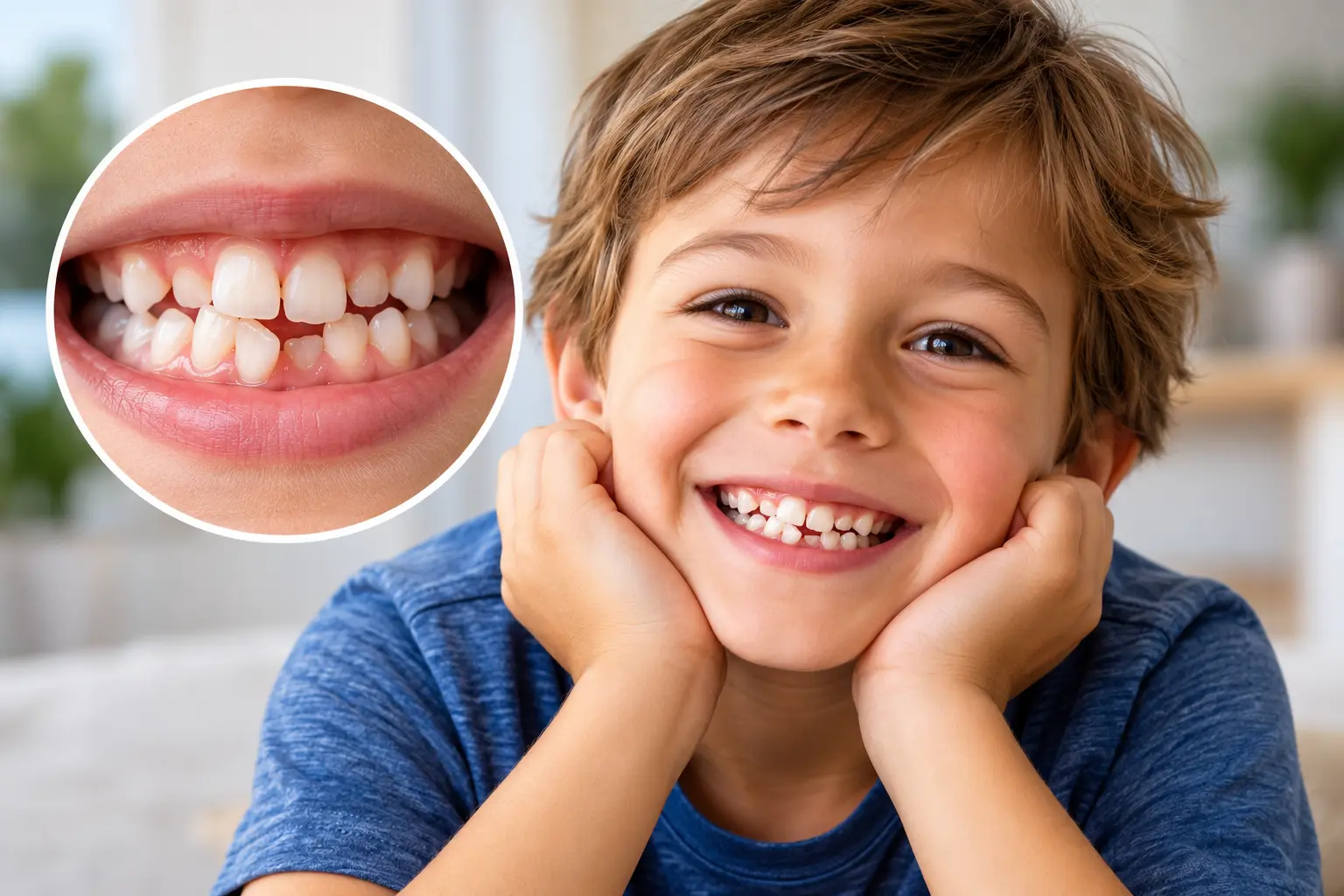


Crowded teeth in kids are often viewed as a future orthodontic problem. Parents may notice overlapping teeth or a permanent tooth coming in at an angle and immediately wonder about braces.
However, crowded teeth can tell us more than whether a child may need orthodontic care later. They can also raise useful questions about dental arch space, jaw development, oral function, and breathing. Crowding does not mean a child has an airway disorder, and it does not prove that the jaw is developing incorrectly. Still, when teeth do not have enough room to erupt, it is worth understanding why.
What Causes Crowded Teeth in Kids?
Dental crowding happens when there is not enough space in the dental arch for the teeth to fit comfortably.
As permanent teeth begin to erupt, parents may notice overlapping teeth, rotated teeth, permanent teeth erupting behind other teeth, or a narrow-looking dental arch.
Several factors can contribute to crowding. Tooth size matters. Jaw and dental arch size also matter. Genetics, tooth eruption, early loss of baby teeth, oral habits, and bite relationships may also play a role.
For that reason, crowded teeth should not automatically be blamed on one cause.
The American Academy of Pediatric Dentistry recommends evaluating the developing dentition as part of a broader assessment of growth, eruption, available space, oral habits, and bite development. Parents can review the American Academy of Pediatric Dentistry guidance on managing the developing dentition and occlusion.
The important question is not simply whether a tooth looks crooked.
A better question is whether the developing mouth has enough space for the teeth that still need to come in.
Why Jaw Development Matters
Teeth do not develop in isolation. They sit within the upper and lower jaws, which continue to grow throughout childhood.
If available dental arch space is limited, permanent teeth may have fewer places to erupt. As a result, they can rotate, overlap, or emerge outside their expected position.
However, this does not mean every child with crowded teeth has a small or underdeveloped jaw.
A proper evaluation should consider several factors. These include tooth size, arch width, jaw relationships, eruption patterns, genetics, oral habits, and overall growth.
This broader view is important because straightening the teeth is only one part of oral development.
At MyoWay, the Programs and Therapy approach considers oral function, breathing patterns, tongue posture, jaw development, and other findings when they are relevant to the individual child.
Can Crowded Teeth Be Connected to Breathing?
Sometimes. However, the relationship needs to be explained carefully.
Crowded teeth alone do not diagnose an airway problem.
The jaws, tongue, nasal passages, mouth, and throat occupy connected anatomical spaces. Therefore, clinicians may sometimes see dental or jaw patterns alongside mouth breathing, nasal obstruction, snoring, or sleep-related breathing concerns.
Research has found associations between certain dental and craniofacial characteristics and pediatric obstructive sleep apnea. For example, a systematic review found that children with obstructive sleep apnea tended to show some differences in jaw relationships and upper dental arch width. However, the researchers also cautioned that some of these differences may not be clinically significant. Parents and professionals can review the systematic review on dental and craniofacial characteristics in children with obstructive sleep apnea.
Another systematic review reached a more cautious conclusion. The authors found that the certainty of evidence was too limited to firmly establish or rule out an association between many craniofacial features and pediatric obstructive sleep apnea. The full systematic review on craniofacial features in children with obstructive sleep apnea is available through PubMed.
That distinction matters.
Crowding can be a clue that encourages us to ask more questions. It is not a diagnosis.
Look for More Than Crowded Teeth
The context around crowded teeth in kids can be more informative than crowding alone.
Parents may also notice that their child regularly breathes through the mouth, sleeps with the mouth open, snores, breathes noisily during sleep, has chronic nasal congestion, grinds the teeth, or has difficulty keeping the lips comfortably closed.
One symptom does not prove that a child has a breathing, sleep, or myofunctional disorder.
However, several signs occurring together may justify a closer evaluation.
Parents who notice mouth breathing can learn more in MyoWay’s article, What Is Really Behind Pediatric Mouth Breathing?.
What Does Mouth Breathing Have to Do With Development?
Mouth breathing is another topic that is often oversimplified online.
Parents may hear that mouth breathing will always change a child’s facial growth. Others may hear that simply teaching a child to close the mouth will correct the problem.
Neither explanation is complete.
Research suggests an association between chronic mouth breathing and some differences in facial and dental development. A systematic review and meta-analysis reported differences in several craniofacial measurements between mouth-breathing and nasal-breathing children. The authors also noted differences in some airway measurements. You can review the systematic review on mouth breathing and facial skeletal development in children.
However, research in this area does not mean every child who mouth breathes will develop the same dental or facial pattern.
Development is influenced by many factors. These may include genetics, airway anatomy, nasal health, tooth size, skeletal growth, oral habits, and muscle function.
Therefore, a child should not be diagnosed from appearance alone.
Instead, clinicians need to determine why the child is breathing through the mouth.
Form and Function Work Together
A child’s mouth is active throughout the day. The tongue, lips, cheeks, and jaw work together during breathing, chewing, swallowing, speaking, and rest. Their function may interact with dental and skeletal development. However, oral function is only one part of the picture. Genetics, airway anatomy, nasal health, tooth size, skeletal growth, and dental development also matter. For that reason, I prefer to look at both form and function.
When we evaluate a child, useful questions may include:
- Does the child appear to have enough dental arch space?
- How are the permanent teeth erupting?
- How do the upper and lower jaws relate to each other?
- Can the child breathe comfortably through the nose?
- Where does the tongue rest when the child is relaxed?
- Can the lips remain together comfortably?
- Are there persistent oral habits?
- Is there an unusual swallowing pattern?
Does the child have sleep or breathing symptoms that require medical evaluation?
These questions give us more useful information than simply looking at one crooked tooth. Parents who want to better understand the functional side of care can also read Pediatric Myofunctional Therapy: More Than Just Mouth Exercises.
Early Evaluation Does Not Always Mean Early Treatment
This is an important distinction for parents.
Having crowded teeth evaluated early does not mean your child will immediately need treatment.
Sometimes the best recommendation is simply to monitor growth and tooth eruption.
In other situations, a child may benefit from an orthodontic evaluation. Another child may need a medical assessment because nasal breathing is difficult. Some children may benefit from an evaluation of oral posture and muscle function.
The goal of early evaluation is to gather information.
It helps determine whether the crowding is mainly related to tooth position, available space, jaw relationships, oral function, breathing, or several factors together.
Therefore, early evaluation should not be confused with treating every child early.
What Should an Evaluation Include?
A complete evaluation should look beyond whether the front teeth appear straight.
Depending on the child, a clinician may evaluate available dental arch space, tooth eruption, jaw relationships, bite development, tongue resting posture, lip closure, chewing, swallowing, oral habits, nasal breathing, and sleep history.
The child’s health history matters too.
For example, chronic allergies, enlarged tonsils or adenoids, persistent congestion, previous airway procedures, snoring, and restless sleep may affect which professional should become involved.
Sometimes that means working with a pediatric dentist or orthodontist. Other cases may require a pediatrician, ear, nose, and throat specialist, allergist, sleep physician, speech-language pathologist, or myofunctional provider.
MyoWay discusses this broader approach on the Conditions We Treat page.
Does Crowding Mean My Child Will Need Braces?
Not necessarily.
Children’s mouths change significantly as baby teeth are lost and permanent teeth erupt.
The amount of crowding matters. So do tooth size, available space, jaw relationships, eruption patterns, and future growth.
An orthodontic professional can determine whether a child needs monitoring, early orthodontic care, or treatment later.
Parents should also be cautious about anyone promising that a particular therapy will guarantee that braces are never needed.
Myofunctional therapy does not replace orthodontic treatment when orthodontic treatment is appropriate.
Instead, pediatric myofunctional therapy focuses on function. Depending on the child, this may include tongue posture, swallowing, oral muscle coordination, lip function, and breathing habits.
MyoWay explains how these areas can work together in Myofunctional Therapy and Orthodontics.
What Can Parents Notice at Home?
Parents do not need to diagnose jaw growth or measure their child’s dental arches.
Observation is enough.
First, look at your child when they are relaxed. Do not ask them to change their posture before you observe them.
Notice whether their lips are usually together or apart.
Next, pay attention to breathing. Does your child appear to breathe comfortably through the nose during quiet activities?
Listen during sleep as well. Occasional noise may not be concerning. However, persistent snoring, open-mouth sleeping, or labored breathing deserves a conversation with an appropriate healthcare professional.
You can also pay attention during meals. Notice whether chewing appears comfortable and coordinated.
Finally, ask questions during routine dental visits.
You might ask whether your child has enough space for the permanent teeth, whether the amount of crowding is expected at this stage, or whether the bite and jaw development should be monitored.
These questions can help turn a cosmetic observation into a more complete conversation about development.
When Should Parents Ask for a Closer Look?
Consider asking for an evaluation if crowding appears significant, progresses quickly, or seems to interfere with permanent tooth eruption.
It is also reasonable to ask questions when crowding occurs with other signs.
These may include persistent mouth breathing, chronic nasal congestion, snoring, restless sleep, unusual swallowing, or difficulty keeping the lips comfortably closed.
The correct next step depends on the child.
A dentist or orthodontist may evaluate the teeth and bite. A medical professional may need to investigate nasal or airway concerns. A myofunctional provider can assess oral function and determine whether collaborative care is appropriate.
Children do not always fit neatly within one specialty.
Sometimes the most useful approach is simply making sure the right professionals are looking at the right concerns.
Crowded Teeth Can Be a Reason to Ask Better Questions
Crowded teeth in kids should not create panic. They should create curiosity.
Sometimes crowding is primarily a dental issue. In other children, it appears alongside differences in jaw development, oral function, breathing, or sleep.
The teeth alone cannot tell us why.
However, early observation gives parents an opportunity to ask questions while development is still taking place.
If your child has crowded teeth along with mouth breathing, snoring, restless sleep, or other oral-function concerns, you can learn more about MyoWay’s pediatric programs and therapy options.
The goal is not to assume that your child needs treatment. The goal is to understand what their growing smile may be telling you.
Frequently Asked Questions
Are crowded teeth in kids always caused by a small jaw?
No. Tooth size, dental arch space, genetics, eruption patterns, bite relationships, oral habits, and jaw development may all contribute. An evaluation can help determine which factors are relevant for your child.
Do crowded teeth mean my child has an airway problem?
No. Crowded teeth do not diagnose an airway disorder. However, crowding that occurs with persistent mouth breathing, snoring, nasal obstruction, or sleep concerns may justify a broader evaluation.
At what age should crowded teeth be evaluated?
There is no single age that applies to every child. Parents can ask about crowding whenever it becomes noticeable. Earlier evaluation may be especially useful when permanent tooth eruption, the bite, breathing, or oral function also raises concerns.
Can mouth breathing affect jaw development?
Research suggests an association between chronic mouth breathing and some differences in facial and dental development. However, the evidence does not prove that mouth breathing alone causes every developmental change. Genetics, anatomy, nasal health, and other factors also matter.
Can myofunctional therapy straighten crowded teeth?
Myofunctional therapy is not orthodontic treatment. It focuses on oral function, including tongue posture, swallowing, lip function, muscle coordination, and breathing habits when appropriate. Some children may need orthodontic care as well.
Should I tell my child to keep their mouth closed?
Not if nasal breathing is difficult. A child who regularly breathes through the mouth may be compensating for congestion or another issue. The reason should be evaluated before asking the child to force the lips closed.
Will early treatment prevent braces?
No treatment can guarantee that a child will never need braces. Early evaluation can identify concerns while a child is growing, but future orthodontic needs depend on dental development, jaw relationships, tooth position, genetics, and other individual factors.