

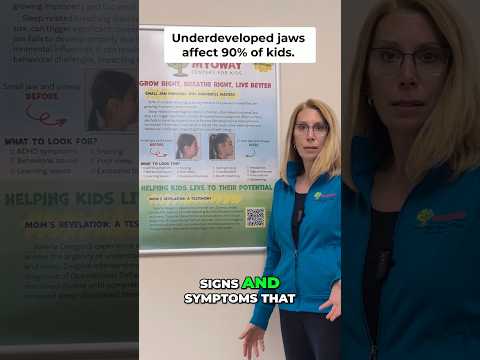
A child can have crowded teeth, an open-mouth resting posture, and difficulty breathing through the nose without those concerns being recognized as part of a larger developmental picture. Parents may notice one symptom at a time, while the relationships between breathing, muscle function, and jaw development remain unexplored.
In a clinical case shared by Dr. Leslie Pasco of MyoWay Centers for Kids, a young girl presented with mouth breathing, an open-mouth posture, and concerns about her jaw and airway development. Her experience illustrates why some children benefit from looking at oral function and orthodontic development together rather than treating them as entirely separate issues.
The important lesson is not that every child who breathes through the mouth needs treatment. It is that persistent mouth breathing, particularly when accompanied by dental or sleep concerns, deserves an informed evaluation.
Understanding how professionals assess these concerns can help parents make better decisions about their child’s growing smile, breathing habits, and overall well-being.
What This Young Girl’s Experience Reveals About Childhood Development
In the case described by Dr. Pasco, the child’s mouth breathing and the way her oral muscles were functioning were important parts of the clinical picture. Her jaw appeared underdeveloped, raising questions about the relationship between her facial growth and airway anatomy.
Rather than focusing on the appearance of her teeth alone, her care involved myofunctional therapy alongside orthodontic treatment.
Dr. Pasco describes meaningful developmental progress following this combined approach. The case provides an example of how addressing oral muscle function and structural concerns together can be valuable when both contribute to a child’s difficulties.
There are important limits to what an individual case can tell us. The video does not provide the child’s age, detailed measurements, treatment duration, or objective sleep-study results. It therefore cannot establish which improvements resulted from therapy, orthodontic treatment, normal growth, or a combination of factors.
Still, the case raises a useful question for parents: When a child’s mouth breathing and jaw development both raise concerns, are we looking at enough of the picture?
A child’s teeth, lips, tongue, facial muscles, and airway do not function independently. Each has a different role, and understanding those roles helps explain why a coordinated evaluation may sometimes be appropriate.
Why a Child’s Jaw Structure and Oral Muscle Function Must Be Evaluated Separately
The upper and lower jaws provide the structural foundation for the teeth and surrounding oral tissues. The tongue, lips, cheeks, and chewing muscles contribute to the movements and resting postures involved in eating, swallowing, speaking, and breathing.
These two aspects of oral development are connected, although neither completely determines the other.
For example, a child may have a narrow upper dental arch that limits the available space for the tongue. Another child may have adequate dental space but difficulty coordinating the tongue and lips during swallowing or rest. A third child may keep the mouth open because chronic nasal congestion makes breathing through the nose uncomfortable.
All three children might appear to have similar mouth-breathing habits, yet their needs could be quite different.
A 2021 systematic review and meta-analysis examining mouth breathing and facial skeletal development in children identified associations between mouth breathing and several differences in jaw position, facial growth patterns, and airway measurements.
These findings support the importance of evaluating breathing habits alongside dental development. They do not prove that mouth breathing alone causes a particular jaw shape or that changing breathing habits will reverse an existing skeletal difference.
Genetics, nasal obstruction, oral habits, muscle function, and normal variations in growth all contribute to the final picture.
For a closer explanation of the muscles involved, MyoWay’s article on how mouth muscles support jaw growth in children explores the roles of the tongue, lips, cheeks, and jaw during everyday activities.
What a Comprehensive Evaluation Should Look For
When a parent brings a child for assessment, the goal should be to understand why the child is showing certain signs, not simply to place a label on the behavior.
A comprehensive evaluation typically begins with questions about the child’s medical history, breathing patterns, sleep quality, oral habits, dental development, and daily function.
Breathing Comfort and Nasal Airflow
One of the first questions is whether the child can breathe comfortably through the nose.
A child who has enlarged adenoids, persistent allergies, chronic nasal inflammation, or another obstruction may keep the mouth open because nasal breathing is difficult.
In that situation, asking the child to keep the lips closed does not address the underlying problem.
A pediatrician, allergist, or ear, nose, and throat specialist may need to evaluate the child’s airway before breathing retraining is appropriate.
Dental Arch Development and Bite Relationships
A dentist or orthodontist may assess whether the child’s upper and lower jaws are developing in a way that provides adequate room for the teeth and normal oral function.
Clinical findings may include a narrow upper dental arch, dental crowding, a crossbite, an open bite, or an unusual relationship between the upper and lower jaws.
These findings do not automatically indicate a breathing disorder. However, they may justify a more detailed discussion when they occur alongside persistent mouth breathing or sleep-related symptoms.
Tongue Posture and Muscle Coordination
Oral muscle function is another part of the assessment.
Can the child maintain comfortable lip closure? Does the tongue move effectively during swallowing? Is there an unusual tongue-thrusting pattern? Can the child coordinate the lips, tongue, and jaw without unnecessary tension?
These observations can identify functional concerns that may be relevant to treatment planning.
The American Speech-Language-Hearing Association’s guidance on orofacial myofunctional disorders emphasizes comprehensive assessment and collaboration among appropriately trained professionals. This may involve dental, orthodontic, medical, and speech-language specialists depending on the child’s needs.
The most useful evaluation is one that recognizes the limits of each provider’s role and makes referrals when another area of expertise is needed.
Why Myofunctional Therapy and Orthodontic Care May Work Together
Myofunctional therapy and orthodontic treatment have different primary purposes.
Orthodontic care addresses tooth alignment, bite relationships, and certain structural concerns involving the developing jaws. Myofunctional therapy focuses on the patterns of muscle movement and coordination involved in tongue posture, lip closure, swallowing, and other oral functions.
When a child has both structural and functional concerns, treating only one may leave an important question unanswered.
Consider a child with a narrow upper arch and a low tongue-resting posture. An orthodontist may determine that the upper arch requires treatment, while a myofunctional therapist may identify tongue or lip coordination patterns that also deserve attention.
The orthodontic component addresses the diagnosed dental or skeletal concern. The myofunctional component works toward more functional muscle habits, provided the child can breathe comfortably and participate in therapy.
Neither approach should automatically be considered a substitute for the other.
There is also a distinction between improving oral function and treating a diagnosed sleep-related breathing disorder. Myofunctional exercises should not be presented as a proven replacement for medical treatment of pediatric obstructive sleep apnea.
At MyoWay Centers for Kids, the Programs and Therapy page explains how individualized programs may include guided exercises, oral-posture training, breathing support, parent participation, and medical-grade appliances when appropriate.
The decision to use an appliance, pursue orthodontic expansion, or begin a muscle-training program should depend on the child’s clinical findings rather than on mouth breathing alone.
How Parents Can Recognize Progress Beyond the Appearance of the Teeth
Parents naturally want to know whether an intervention is helping. When a child receives more than one type of care, progress should be evaluated according to the goals established before treatment begins.
A healthier-looking smile can be meaningful, but appearance does not tell the whole story.
If the initial concern involved oral muscle coordination, progress might include a more comfortable resting lip position, improved swallowing mechanics, or better control of tongue movements.
If dental development was a concern, the orthodontist may evaluate changes in the bite, arch dimensions, tooth eruption, or other appropriate measurements.
When breathing symptoms were part of the original concern, families may be asked to monitor changes in mouth breathing, nighttime noise, or sleep quality. These observations are useful, but they do not independently confirm that an airway has enlarged or that a sleep disorder has resolved.
What Parents Can Track at Home
A simple record of what parents notice can make follow-up appointments more productive.
Useful observations may include:
-
Whether the child’s mouth is usually open or closed during quiet activities.
-
Whether nasal breathing appears comfortable when the child is healthy.
-
How often snoring, noisy breathing, or restless sleep occurs.
-
Whether the child reports dry mouth or fatigue upon waking.
-
Whether prescribed exercises are becoming easier to perform correctly.
These observations are especially helpful when recorded consistently rather than relying on memory from several months earlier.
Parents should also be cautious about interpreting photographs as proof of airway improvement. Changes in facial appearance can be influenced by camera angles, posture, growth, and orthodontic movement.
When a medical breathing concern is suspected, objective medical assessment remains important.
The Sleep Connection That Deserves Special Attention
Not every child who breathes through the mouth has obstructive sleep apnea. Nevertheless, persistent mouth breathing combined with snoring, gasping, witnessed breathing pauses, or unusually restless sleep warrants attention.
Sleep-disordered breathing describes a range of conditions involving abnormal breathing during sleep. Obstructive sleep apnea is one condition within that range and requires appropriate medical evaluation.
The American Academy of Pediatric Dentistry’s policy on obstructive sleep apnea encourages routine screening for risk factors and medical referral when indicated. The policy also recognizes associations between untreated pediatric obstructive sleep apnea and concerns involving learning, behavior, growth, and cardiovascular health.
These associations matter because children do not always show sleep difficulties in the way adults do.
Some children appear sleepy. Others may be irritable, unusually active, or have difficulty concentrating. None of these behaviors, by themselves, establishes that the child has a breathing disorder.
A medical evaluation can help determine whether symptoms are related to sleep-disordered breathing, another health concern, or several contributing factors.
Parents who have noticed nighttime breathing symptoms can learn more in MyoWay’s article What Snoring in Kids Really Means.
If a child regularly snores, gasps, or appears to stop breathing during sleep, discussing those signs with the child’s pediatrician is an appropriate next step. A clinician may recommend evaluation by a sleep specialist and, when indicated, an overnight sleep study.
Why Timing Matters, Even When Treatment Is Not Immediately Needed
Childhood offers opportunities to observe and assess development while the jaws and teeth are still changing.
That does not mean every child needs an appliance or a course of therapy at an early age. In some cases, monitoring growth is the most appropriate recommendation.
The important distinction is between making an informed decision to monitor a concern and overlooking a problem because the child is young.
The American Association of Orthodontists recommends an initial orthodontic examination when a concern is recognized and no later than age seven. Its 2026 explanation of the benefits and timing of early orthodontic treatment makes clear that an early examination does not necessarily mean immediate treatment.
An orthodontist may recommend observation, preventive guidance, or intervention for a particular bite or structural problem.
For children with persistent mouth breathing, timing may also depend on the cause. Nasal obstruction, for example, should be addressed on an appropriate medical timeline rather than waiting for a future orthodontic appointment.
Similarly, muscle training should be suited to a child’s age, ability to follow instructions, breathing comfort, and specific functional needs.
The objective is not to begin treatment as early as possible for every child. It is to identify concerns early enough that families have appropriate options.
What This Clinical Case Can Teach Parents About Individualized Care
Returning to the young girl in Dr. Pasco’s video, the most useful feature of her story is the combination of concerns that were considered.
Her mouth-breathing pattern was not viewed separately from her oral muscle function and jaw development.
Her care involved both myofunctional therapy and orthodontic treatment, reflecting an effort to address functional and structural needs together.
Although the video describes encouraging progress, it does not establish that similar results can be expected for every child.
Some children primarily need treatment for allergies or nasal obstruction. Others may benefit from orthodontic care, myofunctional therapy, speech-language services, or a combination of approaches. Some require medical sleep evaluation before decisions about other interventions can be made.
The appropriate plan depends on what an assessment finds.
For parents, one of the most valuable questions to ask is not simply, “What treatment does my child need?”
It is, “What is contributing to the signs we are seeing, and which professionals should be involved in evaluating them?”
That question encourages a more individualized approach without assuming that every symptom has the same underlying cause.
Questions Parents Should Ask Before Beginning Treatment
A thoughtful consultation should leave parents with a clear understanding of the concerns identified and the reasoning behind any recommendation.
It is reasonable to ask which findings are related to tooth position, which involve jaw structure, and which concern muscle function or breathing.
Parents can also ask how the treatment team will measure progress and what would lead to changes in the plan.
If the recommendation involves an appliance, ask what the appliance is intended to accomplish, what evidence supports its use for the specific concern, and whether an orthodontic consultation is appropriate.
If the recommendation involves myofunctional exercises, ask which functional skills are being addressed, how often practice is expected, and how improvements will be assessed.
For children with snoring or other sleep-related symptoms, ask whether medical screening or a sleep study is needed.
These conversations help families understand what is known, what remains uncertain, and what outcomes are realistic.
They also reinforce an important point: good interdisciplinary care should make the treatment process clearer, not more complicated.
Understanding Your Child’s Next Step
A child who frequently breathes through the mouth may simply be dealing with temporary congestion. Another child may have persistent nasal obstruction, a dental development concern, or an oral muscle pattern that deserves professional attention.
The difference cannot be determined from appearance alone.
If you have noticed ongoing mouth breathing, unusual oral posture, crowded teeth, or concerns about your child’s sleep, learning more about these signs is a reasonable place to begin. MyoWay’s Conditions We Treat page explains the types of oral function, breathing, and developmental concerns that may lead families to seek an evaluation.
A consultation can help identify which questions need further investigation and whether coordinated medical, dental, orthodontic, or myofunctional care may be appropriate.
Book your free consultation in under five minutes. You can schedule a free consultation with MyoWay Centers for Kids to discuss your child’s breathing patterns, oral function, and development.
Mouth breathing in children may be associated with differences in jaw development, tongue posture, and oral muscle function. When structural and functional concerns occur together, some children may benefit from coordinated orthodontic and myofunctional care. A comprehensive evaluation helps identify contributing factors, determine whether medical assessment is necessary, and guide appropriate treatment.
Frequently Asked Questions
1. Can mouth breathing affect a child’s jaw development?
Research has identified associations between persistent mouth breathing and certain facial growth and dental patterns. However, mouth breathing is not the sole cause of jaw development differences. Genetics, airway obstruction, muscle function, and other factors also influence growth.
2. Can myofunctional therapy and orthodontic treatment be used together?
Yes. Some children benefit from coordinated care when both oral muscle function and dental or skeletal development need attention. Each approach addresses different aspects of oral health, and recommendations should be based on an individualized evaluation.
3. How can parents tell whether their child has a jaw development concern?
Possible signs include dental crowding, a narrow dental arch, certain bite irregularities, or difficulty maintaining comfortable lip closure. These findings are not diagnoses. A dental or orthodontic examination can help determine whether development requires monitoring or intervention.
4. Does an open-mouth posture always mean a child has an airway problem?
No. Open-mouth posture can occur for several reasons, including temporary congestion, oral habits, dental relationships, or difficulty coordinating oral muscles. Persistent open-mouth posture warrants evaluation, particularly when accompanied by difficulty breathing through the nose or sleep-related symptoms.
5. Can myofunctional exercises make a child’s airway larger?
Myofunctional exercises primarily target muscle coordination, movement patterns, and oral resting posture. They should not be presented as a reliable way to enlarge a child’s airway. Structural concerns and suspected airway obstruction require appropriate professional assessment.
6. At what age should a child receive an orthodontic evaluation?
The American Association of Orthodontists recommends an initial orthodontic examination when a concern is recognized and no later than age seven. An examination does not necessarily lead to immediate treatment.
7. Does mouth breathing mean my child has sleep apnea?
No. Mouth breathing alone does not establish a diagnosis of sleep apnea. However, persistent mouth breathing accompanied by regular snoring, gasping, or witnessed breathing pauses should be discussed with a pediatrician.