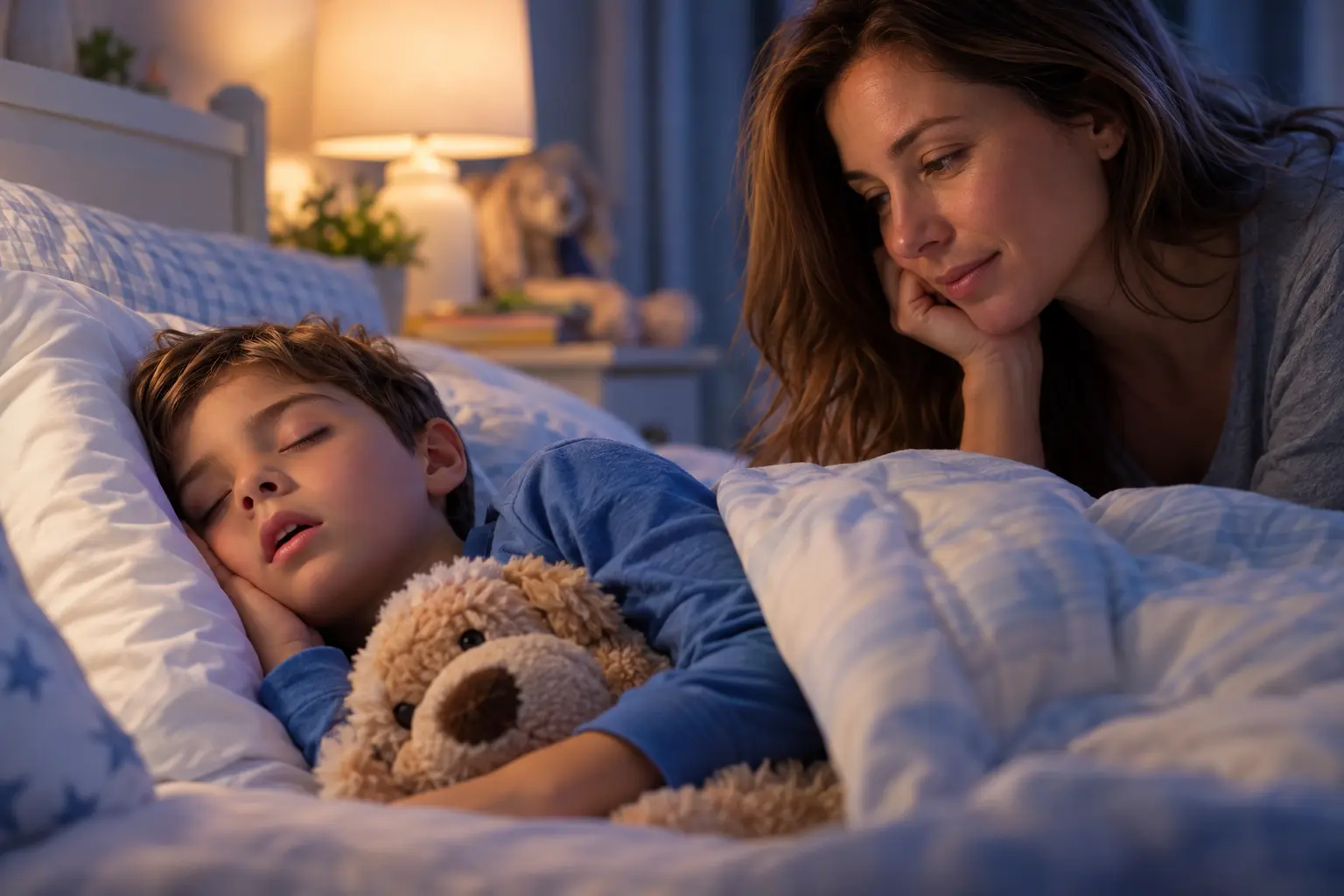

Parents often know when something does not quite add up. Your child may be seeing a pediatrician because of trouble focusing. The dentist may have mentioned crowded teeth or a narrow palate. A speech therapist may be working on tongue placement, swallowing, or an open-mouth posture. At night, you may notice restless sleep, snoring, teeth grinding, or a mouth that stays open.
Each concern can seem unrelated when it appears in a different office.
The difficulty is that children do not experience their health in separate specialties. Breathing, sleep, oral muscle function, tongue posture, dental development, and daytime behavior can overlap. That does not mean one problem automatically causes all the others. It does mean that a pattern involving several systems may deserve a broader look.
One of the most useful things a parent can do is learn how to recognize that pattern and communicate it clearly.
Why Connected Symptoms Can Look Like Separate Problems
Healthcare professionals are trained to evaluate concerns within their areas of expertise. That specialization is valuable. A pediatrician may focus on growth, behavior, development, and general health. A dentist evaluates teeth and oral development. A speech-language pathologist may assess speech, swallowing, oral movement, or tongue function.
The challenge comes when a child’s symptoms cross those boundaries.
For example, a parent may report poor concentration during a pediatric appointment without mentioning that the child snores. The dentist may see dental crowding without knowing that the child sleeps with an open mouth. A speech therapist may observe unusual tongue posture without having access to the child’s dental or sleep history.
No single observation establishes an airway problem. However, several observations together may change the questions worth asking.
The American Academy of Pediatric Dentistry recognizes this overlap. Its policy on obstructive sleep apnea in children notes that pediatric dentists may identify signs and symptoms that raise concern for sleep-related breathing problems and recommends referral to an appropriate medical provider when obstructive sleep apnea is suspected.
That distinction matters. Screening identifies reasons to investigate. It does not replace medical diagnosis.
Start With the Pattern, Not One Symptom
Parents sometimes become focused on finding the single symptom that will explain everything. Pediatric airway and sleep concerns are rarely that simple.
A more useful question is:
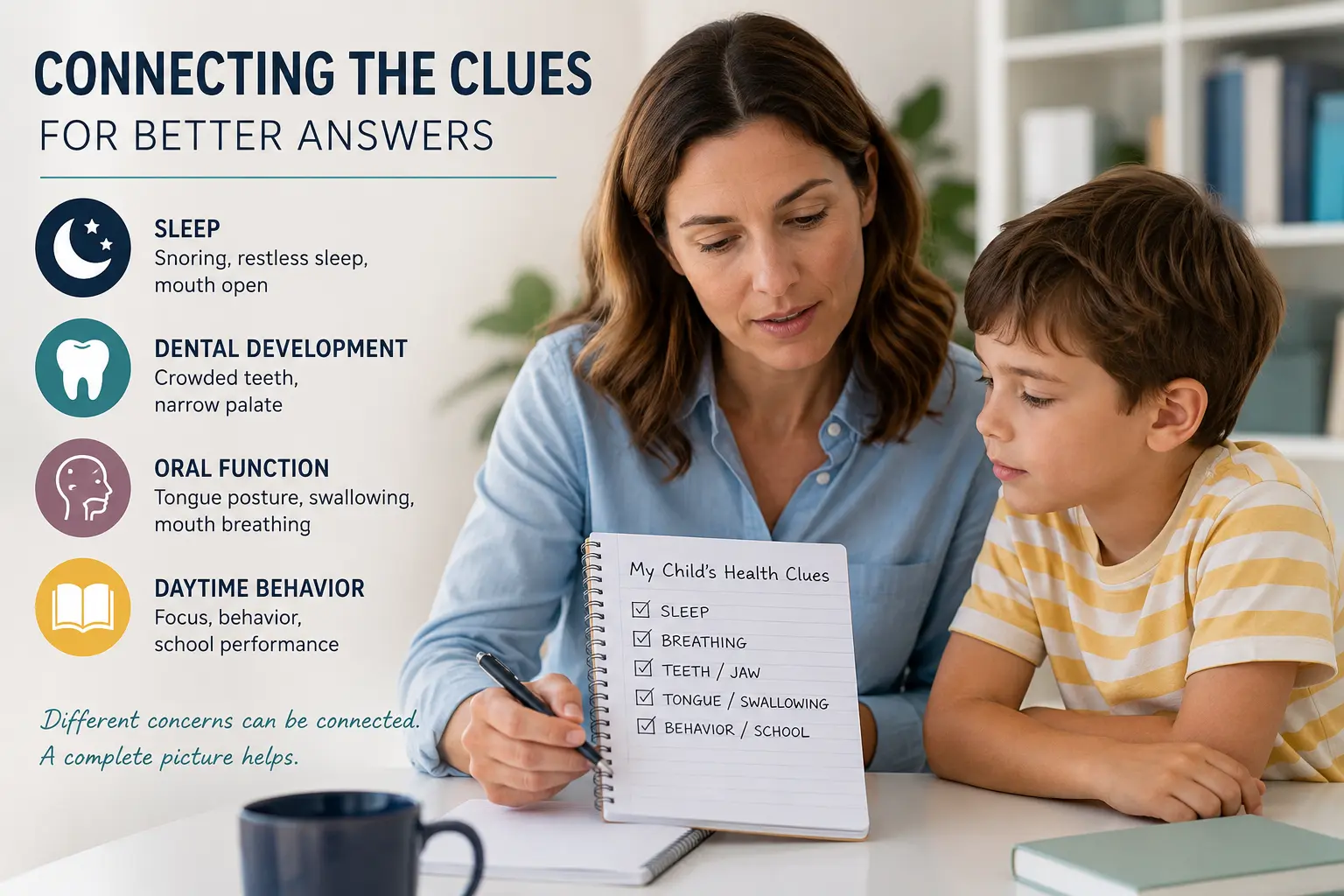
What happens when I put my child’s sleep, breathing, oral function, dental development, and daytime behavior on the same page?
A child who occasionally has difficulty paying attention may not have a breathing problem. A child with crowded teeth does not automatically have obstructive sleep apnea. A tongue thrust does not by itself explain poor sleep.
The pattern becomes more meaningful when concerns repeatedly appear across categories.
For example, a parent might notice:
- Snoring or noisy breathing at night
- Sleeping with the mouth open
- Restless sleep or frequent position changes
- Teeth grinding
- Difficulty waking in the morning
- Daytime irritability or poor concentration
- Lips frequently apart while awake
- Crowded teeth or a narrow dental arch
- Unusual tongue resting posture
- Swallowing or speech concerns
The American Academy of Pediatric Dentistry includes several of these features among signs and history questions that may be relevant when screening children for sleep-related breathing disorders.
MyoWay Centers for Kids also provides an overview of conditions and functional patterns that may warrant closer evaluation for parents who are trying to understand how individual symptoms might fit together.
Sleep Clues Are Easy to Leave Out of Daytime Appointments
One reason sleep-related breathing concerns can remain hidden is surprisingly simple: parents may not realize that nighttime observations are relevant to a daytime concern.
If the appointment is about behavior, the conversation may center on school.
If the appointment is about crowded teeth, the conversation may center on orthodontics.
If the appointment is about speech, the conversation may center on articulation.
Sleep may never come up.
Yet pediatric sleep-disordered breathing has been associated with differences in attention, executive functioning, memory, language, and other areas of neurocognitive performance. A 2022 systematic review and meta-analysis involving 77 studies found neurocognitive differences across several domains among children with sleep-disordered breathing. Importantly, an association does not establish that a child’s behavioral or learning concern is caused by breathing during sleep. It does support asking about sleep when other signs are present. The study is available through PubMed.
Parents who are particularly concerned about the school-day connection can also read how breathing and sleep may relate to academic performance. The important point is not to reinterpret every learning or behavioral difficulty as an airway issue. It is to make sure sleep and breathing are included in the history when the overall pattern warrants it.
Oral Function Can Provide Another Part of the History
The mouth is not only about teeth.
Tongue posture, lip position, swallowing, chewing, breathing patterns, speech, and jaw movement involve a coordinated system. This is one reason an observation made during speech or dental care may have relevance outside that appointment.
The American Speech-Language-Hearing Association describes orofacial myofunctional disorders as patterns involving oral and facial musculature that can affect tongue position at rest and during swallowing, breathing, and speech. Its guidance also emphasizes interprofessional assessment because these concerns can involve several disciplines.
That does not mean every speech issue is an airway issue or that every child with an unusual tongue posture needs the same treatment.
It means oral function deserves context.
If a speech-language pathologist mentions a tongue thrust, for example, parents can ask whether there are other observations they should share with the dentist, pediatrician, or another healthcare provider.
If a dentist notices a narrow palate or dental crowding, parents can mention whether the child also mouth breathes or snores.
Information becomes more useful when it travels with the child.
Dental Development Is a Clue, Not a Diagnosis
Parents are often surprised when breathing comes up during a dental conversation.
Dental professionals routinely see structures that other providers may not examine in the same way. They can observe dentition, jaw relationships, oral posture, tonsillar area, tongue position, and other features that may help identify a child who deserves further screening.
The American Academy of Pediatric Dentistry specifically states that pediatric dentists are in a useful position to identify children who may be at increased risk for obstructive sleep apnea. It also makes clear that suspected obstructive sleep apnea should be referred for appropriate medical evaluation.
That is an important boundary for parents to understand.
Crowded teeth do not diagnose an airway disorder.
A narrow palate does not diagnose sleep apnea.
Mouth breathing does not tell you the exact cause.
These observations can help determine what questions should come next.
Create a One-Page History Before the Next Appointment
Parents do not need to become airway experts. They can, however, become excellent historians.
A simple one-page summary can make appointments much more productive because it prevents important observations from being scattered across years of medical, dental, and therapy records.
Include five areas.
Sleep
Write down what you actually observe.
Does your child snore? How often? Is breathing noisy? Is the mouth open? Does your child move constantly, sweat heavily, grind the teeth, wake frequently, or sleep in unusual positions?
Avoid interpreting the behavior. Simply document it.
A brief recording of sleep can sometimes help a healthcare professional understand what you are describing, although a home recording cannot diagnose a sleep disorder.
Daytime breathing
Notice your child’s resting posture when reading, watching television, riding in the car, or using a tablet.
Are the lips usually together or apart?
Does breathing appear to occur primarily through the nose or mouth?
Does nasal breathing seem comfortable?
Again, observation is more useful than diagnosis.
Dental and oral development
Write down what dental professionals have mentioned.
This might include crowding, bite concerns, a narrow dental arch, grinding, orthodontic recommendations, or observations about jaw development.
Parents who want to better understand what pediatric myofunctional assessment considers can review the MyoWay Centers for Kids programs and therapy overview.
Tongue, swallowing, speech, and oral habits
Include concerns such as persistent thumb or finger habits, tongue thrust, difficulty keeping the lips closed comfortably, unusual swallowing patterns, feeding concerns, or speech observations.
The American Speech-Language-Hearing Association recommends gathering respiratory habits, sleep history, dental and orthodontic history, oral habits, previous interventions, swallowing history, and speech history when evaluating orofacial myofunctional concerns.
Behavior and daytime function
Record what teachers and caregivers are actually seeing.
Examples might include difficulty waking, irritability, daytime fatigue, hyperactivity, trouble sustaining attention, or changes in school performance.
These observations are not specific to airway or sleep problems. Many medical, developmental, psychological, environmental, and educational factors can produce similar signs.
Their value is in showing the entire pattern.
Bring the Same Information to Different Providers
A common problem is giving each professional a different version of the child’s history.
The pediatrician hears about behavior.
The dentist hears about teeth.
The speech therapist hears about articulation.
A better approach is to bring the same one-page summary to each appointment.
You might tell your pediatrician that your child is struggling with concentration and also snores several nights each week.
You might tell the dentist that crowding has been mentioned and that your child sleeps with an open mouth.
You might tell the speech-language pathologist that tongue posture concerns occur alongside chronic mouth breathing.
This does not tell any provider what conclusion to reach. It simply gives each professional more complete information.
Ask Questions That Encourage Clinical Collaboration
Parents sometimes worry that asking about airway or sleep will sound as though they are trying to diagnose their child.
You do not need to arrive with a diagnosis.
Ask practical questions instead:
“Could the sleep symptoms be relevant to what you are seeing?”
“Is this something another provider should evaluate?”
“Are there findings here that I should share with our pediatrician or dentist?”
“Would medical sleep evaluation be appropriate?”
“Could nasal obstruction or another structural issue need to be ruled out?”
“Who should assess this next?”
These questions allow the professional to stay within their scope while helping you identify the next appropriate step.
Know When Medical Sleep Evaluation May Be Needed
Myofunctional assessment, dental screening, and parent observation cannot diagnose pediatric obstructive sleep apnea.
When a child snores and has additional symptoms suggestive of obstructive sleep apnea, medical evaluation may be warranted. The American Academy of Pediatric Dentistry cites pediatric guidance recommending polysomnography, commonly called an overnight sleep study, for children and adolescents with snoring plus signs or symptoms of obstructive sleep apnea.
Parents should also promptly discuss witnessed pauses in breathing, gasping, significant breathing difficulty during sleep, or other concerning symptoms with the child’s medical provider.
An airway-focused conversation should expand appropriate care, not replace it.
What Myofunctional Evaluation Adds to the Picture
A pediatric myofunctional evaluation looks at function.
Depending on the child and provider, that may include breathing patterns, tongue resting posture, lip function, swallowing, chewing, oral muscle coordination, habits, sleep-related observations, and aspects of jaw and dental development.
This is different from diagnosing a medical sleep disorder.
At MyoWay Centers for Kids, the purpose of this evaluation is to determine whether oral posture, muscle function, breathing habits, or developmental patterns may deserve support and whether collaboration with medical, dental, orthodontic, speech, or sleep professionals may be appropriate.
Parents who want to learn more about the distinction can review pediatric myofunctional therapy and what it actually evaluates.
The Goal Is Not to Find One Explanation for Everything
This may be the most important point.
Connecting symptoms does not mean forcing them into a single diagnosis.
A child can have attention difficulties and an airway concern.
A child can have allergies and an oral posture issue.
A child can have crowded teeth without having obstructive sleep apnea.
A child can need speech therapy independently of breathing concerns.
Clinical care becomes stronger when professionals can distinguish what is related, what is separate, and what needs further evaluation.
The goal is not to prove that one underlying problem explains every symptom.
The goal is to make sure relevant information is not lost simply because it appeared in another office.
Frequently Asked Questions
What airway symptoms should I track before my child’s appointment?
Useful observations include snoring, noisy breathing, mouth-open sleep, daytime mouth breathing, restless sleep, teeth grinding, unusual sleeping positions, morning fatigue, difficulty waking, and any witnessed breathing pauses. Dental, speech, swallowing, and behavioral observations can also provide context. These signs are not diagnostic by themselves.
Can behavior problems in children be related to poor sleep?
They can be associated. Research has linked pediatric sleep-disordered breathing with behavioral and neurocognitive differences, but behavior problems have many possible causes. Poor concentration, hyperactivity, or irritability should not automatically be attributed to an airway condition. Sleep history is one factor healthcare professionals may consider.
Does crowded teeth mean my child has an airway problem?
No. Dental crowding alone cannot diagnose an airway disorder or sleep apnea. Dental and craniofacial observations can sometimes contribute useful information when combined with breathing, sleep, and medical history. An appropriate evaluation can help determine whether additional screening or referral is warranted.
Why would a speech-language pathologist ask about breathing or sleep?
Tongue position, swallowing, speech, oral posture, and breathing involve overlapping structures and functions. The American Speech-Language-Hearing Association recommends considering respiratory habits and sleep history when evaluating orofacial myofunctional disorders and emphasizes collaboration with other professionals when medical concerns are suspected.
Who diagnoses obstructive sleep apnea in children?
Pediatric obstructive sleep apnea is a medical diagnosis. Dentists, myofunctional providers, speech-language pathologists, and others may identify risk factors or recommend referral, but they do not replace appropriate medical evaluation. Sleep testing may be recommended depending on the child’s symptoms and history.
What should I bring to an airway or myofunctional evaluation?
Bring information about sleep, breathing, oral habits, dental and orthodontic history, speech or swallowing concerns, previous procedures, relevant medical history, and observations from teachers or other caregivers. A simple written timeline can help the provider understand whether several concerns appeared together or developed at different times.
Should I wait until all of my child’s specialists agree there is a problem?
You do not need a predetermined diagnosis before asking questions. If you consistently notice concerning sleep, breathing, or oral-function patterns, discuss them with the appropriate healthcare professionals. An evaluation can help determine what deserves investigation and whether referral or collaboration is appropriate.
A Practical Next Step for Parents
If several observations on this page sound familiar, start by writing them down rather than trying to decide what they mean.
MyoWay Centers for Kids offers a pediatric airway research and risk screener that can help parents organize common sleep and breathing observations. The screener is not a diagnosis. It can give families a structured starting point for conversations with their healthcare providers.
Families who want a closer look at breathing habits, oral posture, tongue function, jaw development, and related myofunctional patterns can also request a free evaluation with MyoWay Centers for Kids. The purpose is to better understand the pattern and determine whether myofunctional support, additional medical evaluation, collaborative care, or continued monitoring may be appropriate.